sewing

Consumers’ League

Photo credit: Wikipedia

I came across a picture of this label in a book I was listing, called Textiles and Clothing, from 1923. I hadn’t though of the National Consumers’ League in quite a while, and didn’t really know the history, so of course I was interested in finding out more.

The book states that it had existed for 25 years, which means it started around 1898. In reality, it started with four chapters in four states in 1890, with the National Consumers’ League being established in 1899, with the purpose of protecting workers in sweat shops. It was trying to improve working conditions as well as wagers for the workers, most of whom, of course, were women. The labels were affixed to clothing “manufactured in factories under sanitary conditions.” They do have the disclaimer that the label is not a guarantee as to hours or wages, but does mean that it was not produced with child labor. I guess that they had to start somewhere, right? It also meant that state labor laws were obeyed.

The Consumers’ League also published what they called a “white list” of stores that treated their employees fairly. Socially conscious shopping in the Victorian era! Who knew? In reading their goals in an 1899 newspaper, it reads much like the anti-fast fashion movement now: their “chief purpose….is to persuade buyers to practice the new economic virtue of creating excellence by buying excellence,” and to “educate consumers or buyers by bringing before them the conditions under which goods are made and sold, and urge upon them the importance of giving patronage where good goods prevail.” And over 120 years later, we are still fighting that fight. Though child labor and working conditions have been improved in most of the US, many companies have just moved overseas, where sweat shops are still a thing.

The Consumers’ Union originally started in the eastern states, where sweatshops were more prevalent, but by the next year, it was spreading across the country. In Minneapolis, the first attempt to start a branch failed in 1898, but by the next year, it was being well established, with the hard work of a Presbyterian minister. A 1906 article in Cleveland’s Plain Dealer states that all of their funds were obtained mysteriously, without any type of fundraising.

The ladies of Cleveland led the charge during the Christmas season, pushing customers to do their shopping early, so as not to wear out the clerks over the holiday season. They also visited managers to try to get them to give the clerks more rest breaks. You can imagine how this went over! One manager indignantly replied “you have no right to question me…I have as much right to go to your home and inquire how you treat your cook!” Oh, the fragile male ego…….still alive and going strong today!

In 1935, the League was fighting the state of Virginia, where a ten hour day was permitted for female workers, with no maximum. They petitioned to have the womens’ work week limited to 48 hours. Their work has touched all aspects of worker’s environment, from minimum wage to utilities, and everything in between. It is still active today, though they do receive some criticism these days, such as receiving financial support from Amazon, not an icon of fair treatment of employees.

1930's fashion, sewing, vintage clothing, vintage fashion

I’ll Fly Away (on Fabulous Friday)

I was listing this 1935 Excella catalog in the Etsy shop, and I fell in love with this. The one on the left. The one with the collar that could be mistaken for wings. The Dumbo of dresses, if you will. Isn’t it amazing?

The seams. The buttons. The topstitching. Everything combines to make it a memorable garment to enter a room in. This is why I love the 30s so much. It hugs the curves but can stand alone in it’s style. You wouldn’t even need much in the way of accessories for this look to sing. And lest you think that that collar would indeed take flight — NO. The topstitching would help it stay in place just fine.

It’s Friday. I’m in love.

1930's fashion, sewing, sewing patterns, vintage fashion

Irresponsible Fashion

I got this 1931 McCall Quarterly catalog recently. When I was listing it in the Etsy shop today, I came across this article, and it made me smile.

“Sports frocks are somewhat uniform in style. Street dresses have many characteristics in common. But the afternoon costume is another story.

In fact, the formal day mode is varied to the point of appearing irresponsible. But there is really a chic purpose behind each of its moods.

The three models that you see on the right were created for early afternoon hours. and underemonious events. Their formality hints of the casual…in simplicity of lines…fabrics taht are not too elegant…skirts that clear the floor by about ten inches.

For later hours and more formal occasions, designs become a little more feminine, fabrics a ilttle more elegant and skirts quite a bit longer. Sleeves may be either long or short. For a change you may prefer the full-length sleeve in the same from with an ankle length skirt. This combination has a provocative new look about it. “

They go on to talk about choosing accessories: gloves long enough to wrinkle at the wrist, and purses chosen as ornamental, not utilitarian.

It’s funny to look at this with today’s eyes, as we would likely never consider these beautiful garments to be irresponsible or even anything but elegant. But then again, today’s sportswear is anything but elegant, and thinking of an afternoon dress has likely never occurred to the majority of the population. I love this insight into the psychology of fashion in the 30s. It’s one of the reasons I love studying fashion so much, and why, as Miranda Priestley so eloquently put, it’s not just a blue sweater.

1930's fashion, 1970s fashion, sewing, sewing patterns

The Letty Lynton Dress

Joan Crawford as Letty Lynton, 1932. Dress by Gilbert Adrian.

In 1932, the film Letty Lynton was premiered, and with it, one of the most iconic dresses in screen history. Joan Crawford was costumed by the legendary fashion designer Gilbert Adrian, in a dress full of frills and ruffles, and those sleeves. Ms. Crawford, blessed with naturally broad shoulders, was blessed by Mr. Adrian to be dressed in suits and gowns with even broader shoulders, in order to make her waist look proportionally smaller. And what a look that was!

Adrian turned fashion on its access with his broad-shouldered look, and was a genius at fashion marketing, thinking six months forward in fashion so that his gowns didn’t look dated in the time it took to film the movie and get it to market. Depending upon who you believe, there were millions of this style of dress marketed in the months and years following this one showing up on the silver screen. It was a major movie moment. This, of course, is subject to media hype, as it would seem that we’d see some in vintage fashion now.

So when I came across this 1978 pattern, Letty is the first person I thought of. It’s not a dress, though. It’s a wrap top and tiered skirt, but those sleeves have Gilbert Adrian written all over them. I wonder if that’s what the designer had in mind when it was created?

Simplicity 8545, ©1978.

Of course, it could be that the designer was thinking of flamenco, especially given the girl with the maraca on the left, but either way, it’s a cute look that would look great either together or separate.

1920s fashion, sewing, sewing patterns

Excella and Pictorial Review

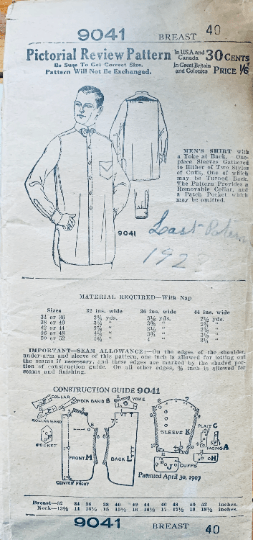
I found out a few months ago that there was a connection between Pictorial Review patterns and Excella patterns. I verified this over the weekend when I realized that I had a men’s pattern from Pictorial Review that I’d also had in the past as Excella.

I don’t know the year on these, and would love to know if they were published at the same time. Look closely at the Pictorial Review, and “last pattern 1928” is written on it. I don’t know if that pertains to this pattern, and it would be hard to say. Though sewing pattern catalogs included some men’s patterns, they didn’t include many, so finding a reference to them from now-defunct companies would be a difficult task.

I saw an article at some point that mentioned the connection they had, but darned if I can find it now. I went searching, and here is what I found. This first mention of Excella in ads was in 1922. Excella patterns were touted as being simple, and that completed projects would exactly match the illustrations. They even had ads saying that if you incurred any loss in creating a garment with Excella patterns, they would reimburse the customer for every penny of loss. Imagine that today!

In1924, Excella began advertising their “Pictograf” which was similar to Butterick’s Deltor, in that it was the name they gave to the instruction sheets. Pictograf later became associated with Pictorial Review. In fact, in 1927, ads are seen for “Excella Pictorial Review” patterns.

In 1934, ads are seen saying that some stores contracts had ended with Pictorial Review, and that they were selling Excella patterns in their place. Pictorial Review patterns were still being sold however, as ads were seen for them up until

Excella ads were seen up until early 1938, though not as frequently as in the earlier years. In contrast, Pictorial Review liquidation sales were seen as early as 1939 and Pictorial Review Magazine isn’t seen after 1940.Any mention of the pattern line disappeared in late 1942. My grandmother worked for Pictorial Review as a fashion editor in the early to mid 1920s, and I believe, from family history, that they were absorbed into McCall’s when they closed.

I would consider this parallel selling of patterns to what Butterick and Vogue did. Vogue would issue patterns, and when sales cooled, they were changed to Butterick and sold with different pattern numbers. I haven’t dived into this practice far enough to show an example, but I know it happened. I’m not sure if it still happens today. Interesting, huh?

designers, embroidery, vintage clothing, vintage fashion

France During World War II

I read the vintage book Fashion Fundamentals, by Bernice Chambers recently, and wow, is it fascinating. The setting is 1947, which puts it post World War II, but before the New Look dominated the scene, so the world was fresh out of not only a war, but fabric rationing and the huge impact of the war on the fashion industry. It includes everything from bios of designers to descriptions of different fabrics and fur. Cool stuff.

What I found most interesting though, was the stories it told of France’s couture industry during the war, and how they were able not only to keep it going, but keep it in France. The Germans wanted to move the couture industry to Berlin. Lucien Lelong, the president of the Haute Couture Chambre Syndical De La Haute Couture, and though he made a couple of trips to Berlin, he pulled off the absolute miracle of defying the Germans and refusing to move. Can you imagine the absolute bravery of going against the Germans, who wanted to take occupied France’s biggest industry away from them?

Think of the impact this could have had. Christian Dior had not shown a collection yet. The entire Berlin fashion scene — iconic in its own way — might not exist as we know it. Moving couture to Germany would have completely turned fashion history on its head. I am amazed.

Add to this that the German officers and their lives liked to shop in the couture industry, and what the designers did to sabotage it, and you will laugh. They purposely made horribly awful, huge hats for the Germans, refusing to offer them top designs. This shows that everyone can be a defiant cog in the wheel of the opposition if they think it through. I just love the visual on this — imagine godawful hats in the windows where the beautiful tiny sculptural hats of the 40s should be, and German women walking out thinking they look amazing whilst the French laugh at them behind their backs.

The other thing that they did was so united. The couture industry was rationed 2/1000 of the normal amount of cloth they normally were used to. A tiny amount. OK, so they can’t make as many clothes, and marketing would be hard if not impossible, but think of how many jobs this affected. This put an entire industry under threat of unemployment during the occupation. What did the designers do? They had limited fabric to work with, weren’t allowed or able to do fabric embellishments like ruffles or pockets, so they did embroidery and beading. LOTS of it. Doing huge intricate designs kept the embroiders employed and families from going hungry.

The pivots that the French couture industry accomplished during the war amaze me. American industry faced its own restrictions, but we were not occupied, and the restrictions weren’t as suffocating. We could still get good cotton, even if we couldn’t get Asian silks or Italian wools. The French had to completely think outside the box, and did it whilst making life difficult for their oppressors. I love it.

The book will be listed in the Etsy shop in the next day or two.

1900s fashion, sewing, sewing patterns

We Must, We Must….Support Our Bust

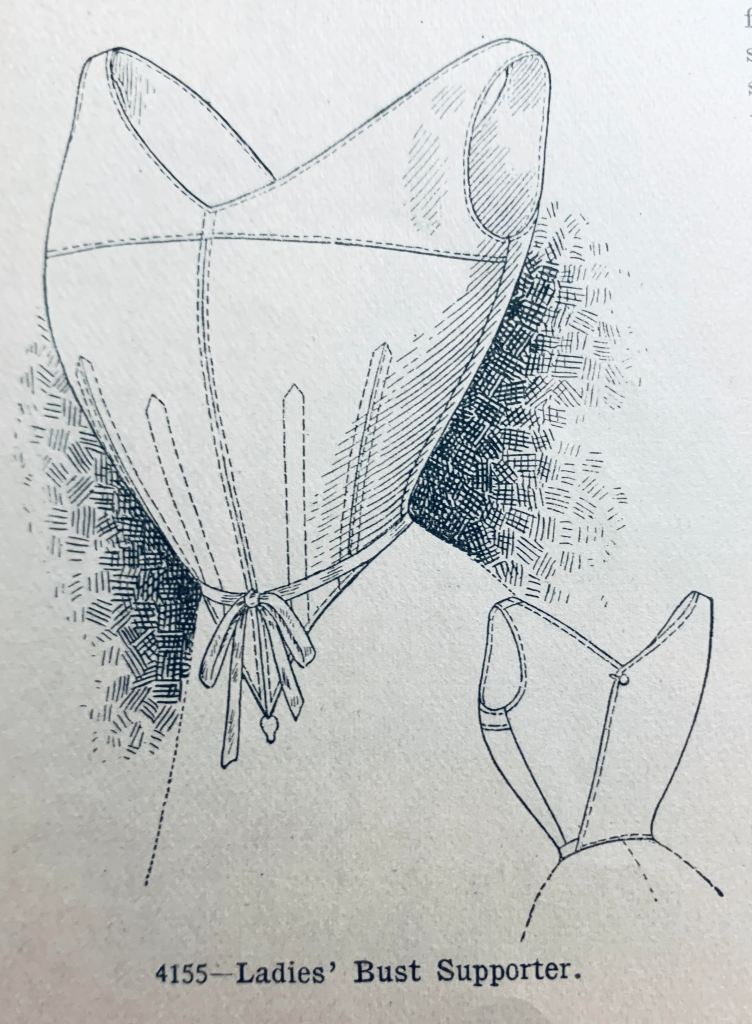
New Idea 4155, ©1906

I came across this pattern in a 1906 issue of New Idea Woman’s Magazine. “For stout figures the bust supporter is almost indispensable, as it gives a trim, firm effect to the figure. It is worn over a corset, and may take the place of a corset cover, though many women prefer to wear a chemise or corset cover with it.”

The front is two sections, a top yoke and a lower boned portion. There are five bones which are eight inches long each. The back buttons at the top of the back, and the tape wraps around from the back to tie in front. I’m not sure the purpose of that tape? It is shown plain but some would also embroider it to make it more dainty, as per the dainty fashions of the era. These were made from coutil (corset fabric) but could also be made from heavy linen or heavy muslin.

Edwardian women wore so many layers, I really don’t know how they could survive in the heat. I am NOT a summer person at all, and never have been, and I think I would’ve been in a swoon all the time. I would like this as a stand alone undergarment if I were not a stout woman though. I think it looks super comfortable if it were made without the boning. God knows it looks more comfy than a bra, yes?

1950s fashion, designers, sewing patterns, vintage clothing, vintage fashion

Fira Benenson

Spadea 1158, ©1958.

I’m reading a 1940s book about the fashion industry, and am learning all kinds of things about lesser known (now) designers. Case in point: Fira Benenson. I’ve seen Fira Benenson patterns before. They are generally 1950s Spadeas, sometimes very early 1960s, but I’ve never heard of her name outside of this. Turns out she’s an interesting person.

I always thought, given her first name, that she had to be Italian, but she was actually Russian. She was a driving force for Bonwit Teller and got her start as the director of imports there before World War II. During the war years, she was the one who designed Bonwit Teller’s collections. She was one of the first retail buyers to return to Paris after the war.

She was very much a team player, saying that no designer designs in a vacuum. “A designer works with the assistance of many people — the fitters, operators, fabric people and her other workers. I would be helpless without my staff.” This is so true, as you’d be surprised how many designers can’t draw, sew or make patterns. Many of them, of course, would never admit it publicly.

Fira Benenson evening dress with jacket in silk shantung, 1942. Photo: New York Daily News.

Ms. Benenson was noted for elegance. She used rich fabrics and embellished with embroidery, shirring, tucking and intricate seams. In 1941, she used a rounded shoulder technique she terms the “hug shoulder” to accentuate women’s curves. That same season, she showed a “soupcatcher” waist, with horizontal looped draping below the waist that created a shelf -hence the soupcatcher name. It was basically a front pannier and based on a Victorian fashion, and created a beautiful, draped effect that accentuated a tiny waist.

Fira Benenson evening dress, 1957. Photo: Rochester Democrat and Chronicle.

“Miss B”, as her staff called her, was soft spoke and gracious, always wearing black, and generally a shirred dress of her own creation. She always wore a huge black pearl left to her by her mother, surrounded by ribbons of diamonds. She was born in Russia in 1898, the child of the Czar Nicolas’ banker, and came to the United States in 1921, after the death of her mother. She opened her own dress shop and was recruited by Bonwit Teller in 1934 to head up their Salon de Couture. This required frequent trips to Paris to view the collections, as she did not design at this point. She only began designing again in 1940 when the war made it necessary. She opened her own shop again in 1948, going into the wholesale business. She maintained both couture and ready to wear collections, as she felt that women wanted clothes that looked “made to measure” to be widely available.

In private life, Ms. Benenson was the Countess Fira Ilinska, married to a Polish nobleman. She spoke seven languages, collected Belgian blown glass, and was known for her dinner parties, where she did much of the prep and cooking herself. The count and countess celebrated 30 years of marriage in March 1961 with a posh dinner party at their apartment that included many of the same guests who originally attended their wedding, including diplomats, artists, writers and businessman. Four months later, the count died in Paris from heart disease. He was 64. Ms. Beneson died in 1977 in the New York apartment she had called home for many years.

sewing, vintage clothing, vintage fashion

Gown of the Year

As the fashion industry began to hit its stride after World War II, new fashions began to be seen. Dior’s New Look, of course, was one. Dresses began to be made with voluminous amounts of fabric that weren’t allowed during wartime rationing. In New York, a contest for “Gown of the Year” was held.

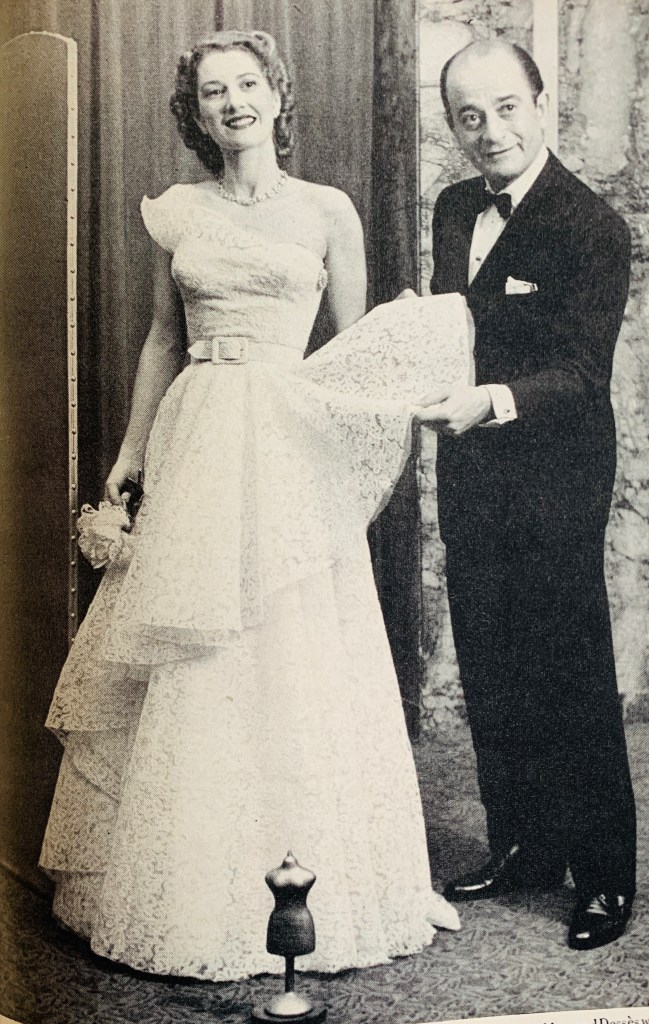
14 designers were asked to submit their designs, and they were worn by socialites at the ball. The jury was all men (!), and included Basil Rathbone, Richard Aldrick (a producer), and singer Morton Downey. The winner? Jean Desses, who had not only never been to the US before, but had never exhibited a dress here.

The ball gowns were worth a total of $7650 and were designed by Sophie, Jo Copeland, Christian Dior (New York), Henri Bendel, Ceil Chapman, Mme. Garnett, Desses, Carrie Munn, Lilly Dache (who I didn’t realize designed dresses, as she was known for hats), Oleg Cassini, Charles James, Omar Kiam, Nettie Rosenstein, and Adrian. Shown here (designers as listed above, from left to right).

The winning gown, with Msr. Desses on the right.:

Photo: Life Magazine.

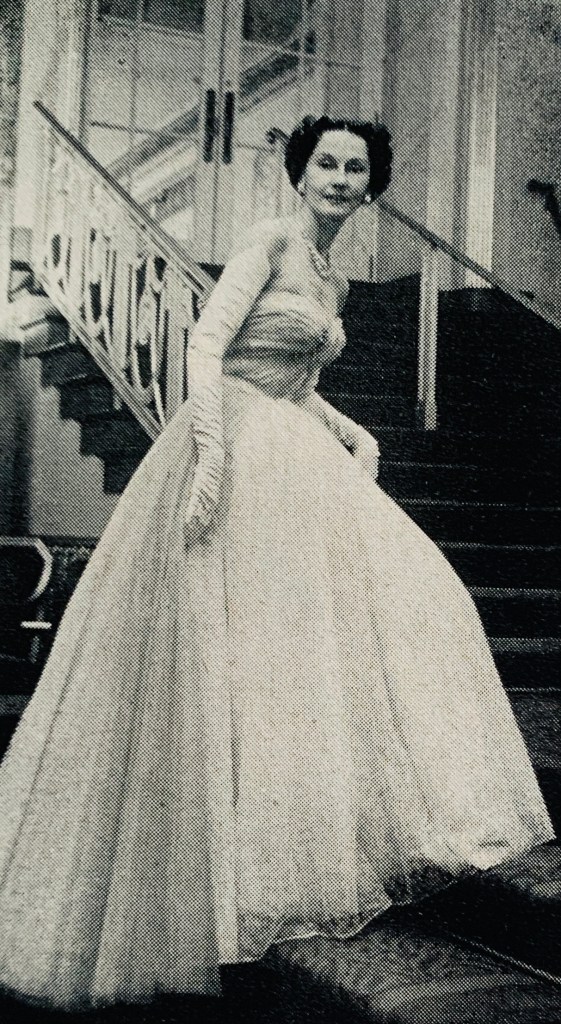
The Christian Dior, New York dress, constructed 80 yards of lace and tulle just in the skirt:

Photo: Life Magazine

The Carrie Munn design. Is that skirt quilted?

Photo: Life Magazine.

The (fantastic) Adrian dress:

Photo: Life Magazine.

No word on the criteria for design or judging, other than it needed to be considered as Gown of the Year. I don’t know if they continued this contest yearly, or if it was just to jumpstart the fashion industry, but I’d love to see something like this today. I doubt we’d see it, as designing for a contest is probably too cost prohibitive for today’s fashion houses, but it sure would be interesting to see. With some female judges this time, please?

Celebrity, designers, Hollywood, sewing patterns, vintage fashion

The Whole (?) List

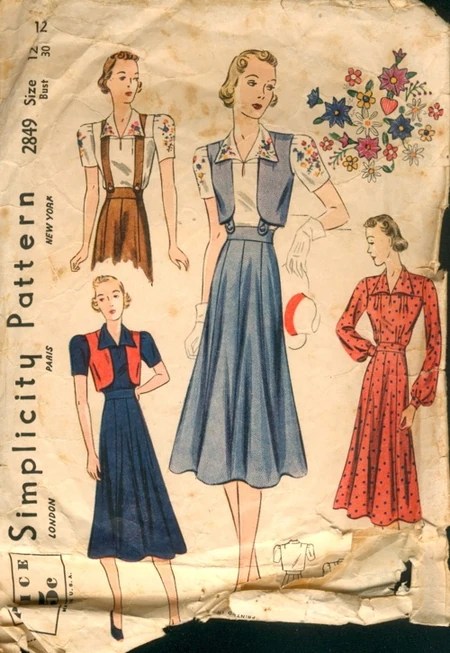
Simplicity 2849, ©1938

After the discussion about unknown designer patterns yesterday, I went to look for as many of the Doublemint Gum designer patterns as I could find. Here is the list. There may be more, but these are all I could find at the moment.

Simplicity 2849, above, is attributed to Sonya Henie as the designer. Now, Sonya was a prolific skater, but did she actually design this, or were they just using her name? We will never know for certain.

Simplicity 2718, ©1938

This cute number was modeled by Joan Bennett in the ads, and is attributed to designer Elizabeth Hawes.

Simplicity 2902, ©1938

This beautiful suit was modeled by Claudette Colbert and designed by Travis Banton.

Simplicity 2951, ©1938.

This ad featured Deanna Durbin, with the pattern being attributed to Vera West, “Universal Pictures’ Fashion Creator.”

Simplicity 2978, ©1939

This one is different. Though it mentions the movie The Last Frontier/aka The Real Glory, the ad does not mention a designer. If it was designed by the costumer of the movie, it would be Jeanne Beakhurst, but there’s not a way to confirm this attribution.

That is the only one I can find for 1939 that mentions an actress. It may be the only one, and perhaps the movie/designer/actress/pattern/gum collaboration was confined to 1939, but considering they snagged Schiaparelli and Valentina, I’d say it was pretty successful, wouldn’t you?