1970s fashion, sewing, sewing patterns

Authentic Western Patterns

I have a great deal of western and square dance patterns from Authentic Patterns, but I don’t know much about them. They have 70s style illustrations and photos, and are pretty cool styles. All I knew was that they were out of Fort Worth, Texas. Then I went looking.

I found that Authentic Western Fashions, Inc. was established in 1970, after Bob McClelland, Sr, a fabric salesman, found a gap in the market. He was the inventor of the infamous (in vintage sewing circles) three armhole dress. I’ve sold a lot of three armhole dress patterns over the course of time. It’s exactly what it says it is: a wrap dress with three armholes. Still very popular, so if you have one, you’re a lucky camper. But apparently, Mr McClelland spoke with fabric salespeople in the course of his work and found that there weren’t a lot of true western style patterns on the market. That’s how Authentic Western Fashions came to be.

McClelland hired Marlene Syms, from Oklahoma, as his designer, and off they were to the races. Specific fabrics were sold as well: stretch lame and iridescent eyelash fabric. Imagine how eye catching these were! Of course, it goes right alone with the country stars of the era with their spangles and sequins, so I guess it’s not really a surprise, though I’d love to see the actual fabrics they were intended for.

Within four months of creation, the company had patterns in several hundred stored nationwide. Plans were made to expand to English riding costumes, as well as cheer and twirling outfits. Though I’ve never seen those, a 1976 article mentions body suits, pantsuits, square dance dresses, and even bush jackets for men. I have a number of western wear patterns for men, women and kids, including a lot of square dance outfits.

It appears that Ms. Syms unfortunately died in 1976 as a result of a car accident in Oklahoma. Though a classified ad is seen looking for a printerman in 1977, the last mention of Authentic Patterns is in a store ad in 1979. It may be that they hired another designer, or perhaps they were still selling Ms. Syms’ designs, as westernwear is fairly classic in style, so it could withstand a certain amount of time without looking dated. No mention is seen of the company in ads after that point.

sewing, sewing patterns

Home Ec

I took Home Economics in eighth grade. There were two semesters: cooking, followed by sewing. I only took the cooking semester, because there were boys in shop class, which meant I went off to wood shop for second semester. What a waste of my time.

I’ve always been interested in home economics classes as they pertain to sewing. I’ve come across a lot of home ec books over the course of time and have read the fascinating book The Lost Art of the Dress, which recounts the history of home ec classes and how the women involved influenced fashion. It’s interesting stuff, if that is the kind of thing that you, like me, nerd out over.

I came across a couple of books that talked about teaching sewing in schools and found the details interesting. They correlate quite a book with the aforementioned book’s timeline, in that sewing at home ebbed and flowed. The late forties were more of an ebb in home sewing, and the 1948 book I found said that in a study of a tenth-grade high school class, only one student had ever used a sewing pattern, only a third of the girls’ mothers sewed, and less than half of the classes’ homes had a sewing machine. That’s a lot of idle machines. Students started by learning to sew a simple gingham sewing bag which was used to hold supplies, and then gradually advanced to sewing garments.

An 1894 book by the Superintendent of the Philadelphia schools, it is noted that sewing began being taught in schools in 1880 and began to be a part of the regular curriculum five years later. Instruction began in third grade. The city provided supplies like pins, thread, thimbles, needles, scissors (regular and buttonhole), cotton for sewing and darning, dressmakers’ scales, emery bags, and paper for drafting patterns. One square foot of muslin was given to each student and was replenished as necessary. The city allotted six cents per student for these supplies.

Classes started in third grade with the most basic of principles: posture while sewing, and how to correctly position one’s hands. Right- and left-hand position were taught separately. Drills were in threading needles, taking a stitch and drawing through fabric, and how to hold scissors. Sewing instruction began with turning the hem, basting and then sewing the hem. Frequently these skills were taught using paper first, instead of fabric. They then learning how to overseam on turned edges, and how to cut a straight line. If students were successful in straight cutting, they were allowed to bring towels and washrags from home to practice hemming.

Second semester of third grade taught back stitch, running seam, half back stitch seam, raw edges of seams to be overcast, hemming of towels, napkins and desk covers. Actual sewing began this semester, with creation of sewing bags, pillowcases, oversleeves, iron holders and bibs. The most amazing thing to me is that in this semester, third grade, with a bunch of eight and nine year olds, they began teaching pattern drafting, by creating patterns for bibs and simple waists (blouses) with straps over the armholes. Most home sewists today don’t know how to draft patterns, and they were teaching babies! Amazing.

In fourth grade, reversible seams were taught, as well as square patches. Hemming of tablecloths and sheets were done, and pillowcases, dust caps, pen wipes and other little projects were sewn. At this point, students were taught how to sew on a four holed button. Drafting projects included yokes, under waists with seam over the arm, and book covers. Second semester, students learned gathering and darning, made plain aprons and book covers, and learned to sew buttons on shoes and basic mending. Drafting projects included under waists with under arm and shoulder seams, aprons, children’s and baby dresses.

Fifth grade lessons were done in narrow hems and fells (flatting the seam, turning it and then sewing it down), tucks and fine gathering, darning, French fells, angular patches, and buttonholes. Sewing projects were drawers, combing capes, shoe and stocking bags, aprons, under waists and plain skirts. Drafting of drawers and under waists with one dart and with spring (curve) to fit the hip were taught.

Sixth grade paid attention to buttonholes, and also taught round patches, herringbone and feather stitches, gusset and bias seams. By this time, girls learned to make chemises, blouse waists, night shirts and flannel skirts. They drafted chemises, gored skirts, dress sleeves, night shirts and blouse waists. Seventh grade taught French gathering, tailored buttonholes, cutting and fitting of plain garments like night dresses, corset covers, and men’s shirts. Patterns were drafted for these garments.

Eighth grade found students cutting, fitting and sewing garments of all kinds, with special attention to men’s shirts and garments that fit the students. Drafting was done for dress waists, sleeves and skirts.

The Philadelphia school system employed 41 sewing teachers to instruct 58,000 students in these skills. They really invested in the program, and the girls, by the time they graduated eighth grade, would have learned all the basic skills to draft patterns and sew their own wardrobe, as well as for family members. Keep in mind that this was also all hand sewing! Amazing, isn’t it?

1920s fashion, designers, sewing, sewing patterns, vintage clothing, vintage fashion

When a Designer Pattern isn’t a Designer Pattern

I’ve been uploading some patterns to the Vintage Sewing Patterns Wiki. They are from an August, 1926 issue of Pictorial Review magazine, and wow are the styles beautiful. I’ve come across this lately more than once, and figured it deserved a bit of a spotlight: sometimes designer patterns aren’t designer patterns.

We all know about designer patterns by Vogue, which include everyone from Schiaparelli to Oscar de la Renta. Many of you know about the designer series by Advance, which included designers like Jo Copeland and even Adrian (I have two. See them here.). Spadea, of course, did tons of designer patterns by Ceil Chapman, the Dutchess of Windsor, and many, many more. McCalls had patterns by designers like Givenchy and Geoffrey Beene. There are even some mail order designer patterns — Charles James did two. I’ve been lucky enough to have one. But did you know that some designer patterns are not labelled as such?

The pattern above, for example, was “designed after Lanvin.” It is Pictorial Review 3405. It was not labelled as a designer pattern, and most likely was not approved by the couture house, but back in the day, it was regular practice to send people to the couture fashion shows in Paris, with their only purpose to be making copies of the designs. They would sketch out the designs, then come back to America and have patterns made from the sketches. This Pictorial Review has four pages of “designed after” patterns from Lanvin, Worth, Molyneux and more. They’re gorgeous.

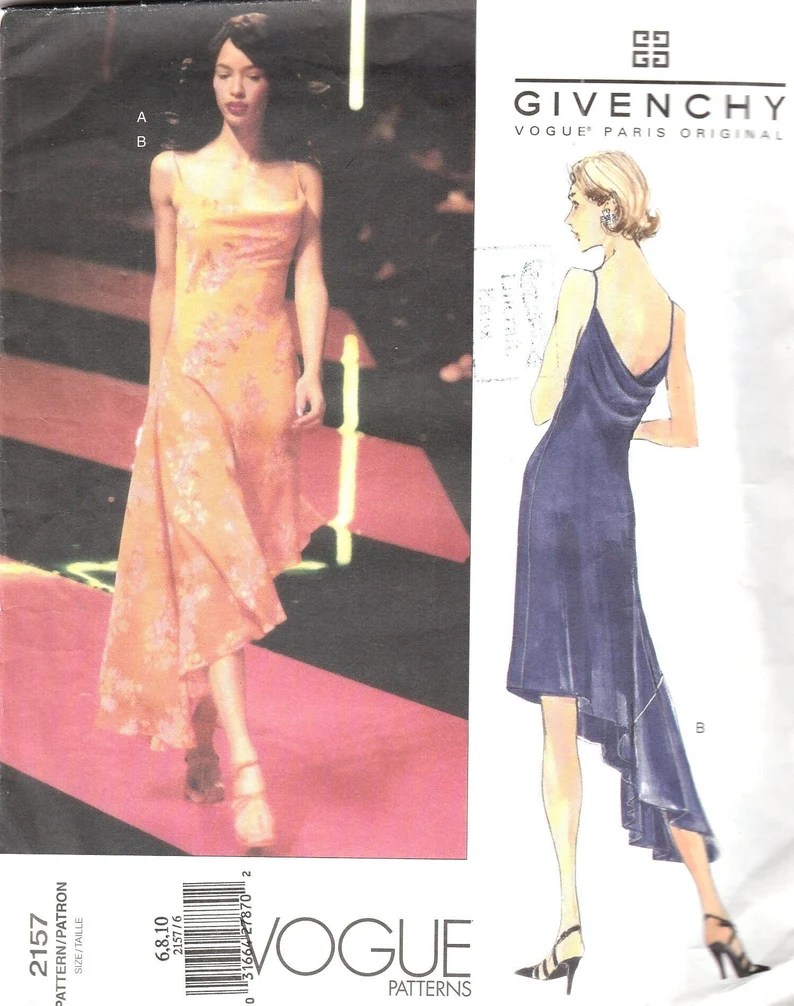
In the more modern era, you can find patterns attributed to Alexander McQueen by looking at Givenchy patterns from the era when he was their designer. Here’s one:

I recently sold a Chloe that was most likely Karl Lagerfeld as well. These are the things you find when you do a deep dive into sewing patterns. I find it fascinating, and maybe others do too. I just really love nerding out over the history involved in sewing and the patterns women used. Perhaps they knew what they had. Perhaps they didn’t care. But the details in it are so interesting to me. You never know what you have till you know what you have.

sewing, sewing patterns, vintage fashion

Where I’ve Been and Other Stuff

Well, I’ve been gone for a while and it’s not been fun. I’ve been fighting a terrible case of tendonitis that has just left me miserable. I did something stupid that I knew would cause problems, and now I’m paying the price. I decided to start doing some gentle workouts but historically, I cannot do any type of upper body exercise at all, or it flares things up. This is the worst it’s ever been. Stupid is as stupid does. I’m trying to figure out the name of the chiropractor I went to several years ago. She adjusted my elbow, which I didn’t even know what possible, and it was the first time in my adult life that I went six months without elbow pain. I need to find her again, but I’m having problems.

I’ve also been to rheumatology and she is going to start me back on infusions for my rheumatoid arthritis, because I’ve developed a nodule. It makes my right index finger go numb, as if pain in every joint of my body isn’t enough. Sheesh. I’m getting a lot of relief from my paraffin bath (scored for $5 at Goodwill!), and recently bought these mittens and these compression gloves, so I can settle in with my mittens and my lavender neck roll and look like the mess that I am. At least it smells nice.

So I haven’t been listing much for almost two weeks because yeah, pain. Severe pain. I did power thru and have the horror quilt almost done. I do the final class today and whilst it looks kind of wonky and she will have to help me straighten it out, I’m going to tell my son that the chaos is just part of the theme. The quilting teacher is looking for help, so I may finagle some lessons from her in exchange for some social media love. Either way, I’ve learned a lot (you learn more from your mistakes, right?) and am going to probably try this again in the future. I’m going to use some of the leftover fabric to make my son’s girlfriend a horror-themed floppy hat that she can wear when they go to horror marathons at the drive in. I’ve never made a hat before, other than knitting, so I’ll probably use McCall’s 8254 and use View B.

I have plans to do a jumper dress for the grandgirls after this, but I think I have to learn to do buttonholes. That’s where either the quilting teacher or YouTube comes in. It’s insane to think that I have sold sewing patterns for nigh on 25 years but have never learned to sew other than basic seams. I’m going to keep plugging away though.

There’s a 25% off sale on all of my venues. Click here to access all of my shops. Sale ends at midnight tonight.

sewing

Horror-fying

It’s getting colder, which means I’m getting ready to go into my winter foray of sewing (poorly). I’m trying not to actually pull out my sewing machine for a while, because at the moment the sunroom table where I sew is literally covered in patterns and Aunt Martha’s transfers, and hubby will have a fit if I put more on there. It is, for the record, in his direct line of vision whilst he is on the couch (which is all day and night), so I do try to keep the pandemonium down to a minimum.

Our little town recently got a fabric store. This is a huge bone of contention between me and my husband because its been my dream to open a really good fabric store. Indiana is a fabric desert, with the sole exception (that I know of) being The French Seam, in northern Indianapolis. It’s small, but it has beautiful fabrics, and isn’t just a dearth of fleece and quilting cottons, a la Joann’s. I’ve been saying for years that I want a fabric store, and would love for it to be something like Vogue Fabrics in Chicago. We are, after all, just off the interstate. Hubby has been quite firm in saying it would never fly in our little town. He’s lived here much longer than me, so he might be right, but don’t kill my dream, man.

Then I saw that someone beat me to it. DAMN.

I haven’t been in there yet, but have been watching their Facebook page to see what they’re about. Kind of wondering if I could drop off some cards to point people my way, but haven’t decided. Then I saw that they are having sewing classes and thought, eh, maybe. Then I saw that they are doing beginning quilting classes and thought what the heck, I’ll do it. My only foray into quilting was making T shirt quilts for my husband’s boys out of their mom’s Race for the Cure shirts. They weren’t particularly well made, but at least one son appreciated it (the other threw his over the fence at me in a fit of anger. He won’t be getting it back. He’s a 50 year old brat.). I thought oh well, I can go take a class on a couple of Sunday afternoons and see what I can do.

I tried to figure out what the heck I was gonna do. The last thing we need in this house is more blankets. We have SO many. I had a memory quilt made for me last year out of my mom’s clothing, and love it. My daughter doesn’t need any more either, so making one for the grandkids was kind of out, at least for now. So I decided to make one for one of my boys. I have a bunch of my youngest’s T shirts from back in the day, and plan to make him a quilt from them, so that just left my oldest. But what kind of theme do you use for a 33 year old bachelor who is a complete free spirit who loves movies?

Why, a horror quilt, of course.

Horror is his favorite genre, so I picked out a ton ton of horror themed fabric (think: The Shining twins, Chucky, old school Dracula and Frankenstein, Freddy Krueger) for the front. The background? Blood spatter. The borders are creepy trees and more blood. I am SO creeped out by it all. I don’t like scary, even less do I like horror. The people in this class are going to think that this crazy old lady is insane, but I think it’s hilarious. Our town is super, super conservative in all of its thinking. Me? Not so much. I may need to video the reaction people have when they see what I’m doing. My friend, an expert quilter, thinks the whole concept is absolutely wonderful. This, coming from someone who goes to yarn conventions for excitement. Maybe I’m on to something?

Then I had a conversation with the Heir to the Throne, who doesn’t know I’m doing this at all. He was talking about The Sandman. Raving, in fact, about how it’s one of his favorite pieces of literature, and how Death is his favorite character. Well, now I had the back of the quilt figured out. It’s going to be quotes from The Sandman. I bought it on Spoonflower, here. See some of my other crazy choices here, here, here, here, here and here.

I’ll post pictures when I’m done. Class isn’t until the last two weekends of November.

designers, sewing, sewing patterns, vintage clothing, vintage fashion

Van Martin and Being a Creator

McCalls 7575, ©1981,

A new listing in the Etsy shop: this track suit style jacket by McCall’s, labelled Van Martin. It’s from 1981, when track suits were starting to become a bit more stylish. The pattern is only for the jacket though. It looks comfortable, because it has an inverted pleat down the back, to give you room to move, and you can make it with anything from poplin and linen to double knits and velour. It’s pretty versatile (and this one is a bust 40, which is nice for today’s ladies).

Van Martin was a sportswear designer. I like what he had to say in this article from the White Plains Journal-News. He said [sewing] “is a means of expressing my creativity. When you cook a meal, you create something that’s never before existed, and that’s what you do with sewing.” Isn’t that cool? You may buy a pattern, even a pattern that’s existed and been owned by various people for a hundred years, but you still are creating something that’s never existed before, because you are choosing the fabric, buttons, zippers, trims all yourself and making it your own. You are a creator. I love the existentialistic idea of that.

Deep thought for a Monday, isn’t it?

designers, sewing, sewing patterns, vintage fashion

Leona Rocha

Simplicity 6433, ©1984

I listed this pattern in the Etsy shop this week and thought who in the world is Leona Rocha. Well, first and foremost, she is apparently not related to Coco Rocha, who is the first person who came to mind. I went looking, and here is what I found.

Leona Rocha was a fit expert. Born in Hawaii, she originally enlisted in the Army’s dental technician course. She used her GI bill benefits to train as a designer at the FIT, she was a past president of the American Home Sewing Association, and even wrote a book about fitting with simplicity. She was a founder of a sewing notions company called Fashionetics, and was the inventor of The Fashion Ruler while still a student, and it is still sold today. In the early 80’s, she partnered with Simplicity to do seminars about fit. At that time, she also hosted a TV show called The Sewing Show on cable four days a week, twice a day. It was a thirteen week series about how to sew at home and properly fit home sewn clothing. She later became an executive at Vogue-Butterick patterns — and married one of their executives. She ran for office on Maui, where she still lives today.

Seems like with all of these accomplishments, I would have known something about her, so I’m glad that now I do. She has left a great legacy to the sewing community.

sewing, sewing patterns, vintage clothing, vintage fashion

Kinda Surprised

Simplicity 9846, ©1980.

I just added this pattern to the Etsy shop, and I am surprised. It’s from 1980! When you think of the 80s, you probably think of huge shoulders and Dynasty-esque fashions. That is partially right, as those types of styles started showing up around 1984 or so, but the cusp of the 70s and 80s had some very soft, beautiful fashions. The most popular Gunne Sax patterns were from 1979-1981, so there was a lot of gorgeous stuff before it got all serious.

That being said, I would’ve put this one in the late sixties or early seventies. It has a Game of Thrones or Renaissance vibe to it because of that cape, and those weren’t seen commonly in the 80s. If you take the cape away, it’s a distinctly Victorian vibe as was common in that time period. That cape definitely IS the look. Make the dress in a deep color with metallic trim and it could be Mother of Dragons cosplay. Am I wrong? Maybe, but it’s a stunning combination nonetheless.

sewing, sewing patterns, vintage clothing, vintage fashion

Easy-Mark Patterns by McCall’s

McCalls 6181, ©1961

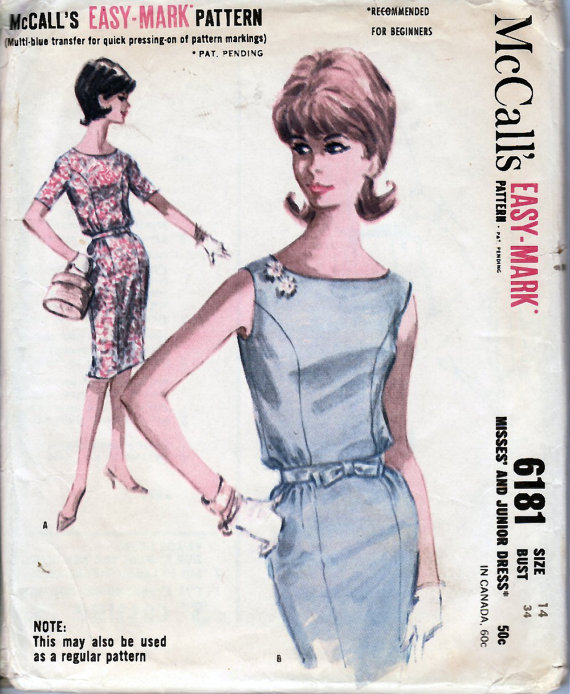
I came across this pattern the other day and learned something new. I noticed the note at the bottom: NOTE: the may also be used as a regular pattern. What the heck? I’d never seen that before. I noticed that at the top it is labelled an “Easy-Mark Pattern.” Turns out that McCall’s put out Easy-Mark patterns starting in 1961, starting with 6004 (a dress), 6098 (blouse) and 6050 (skirt). I guess these three were a test balloon to see how well they did. They premiered the concept at the American Homemaker’s Association Convention in Cleveland, Ohio in July of 1961. The patterns hit stores shortly afterward.

The premise was that a transfer was included so that you could easily transfer the pattern markings to your fabric. As noted, you could use it as normal too. Using the transfer meant you could use your iron to press the markings onto the wrong side of the fabric, thus avoiding the use of tracing paper, carbon, or tailor’s tacks, and avoid damaging the patterns with pins. The transfers were blue, so they were made for use with lighter colored fabric, where the marks wouldn’t be lost. The transfers were able to be used twice, which meant that if you relied on them, you could only reuse the pattern one time. Of course, patterns could be used infinitely if you didn’t need to use the transfer.

These patterns were marketed at the same time as the “Instant” patterns by McCall’s. I suspect that the Instant line may have had more longevity, as I’ve seen tons of them over the years, and this is the first time I’ve seen an “Easy-Mark” pattern. The concept would never fly today because of the cost factor. I’m sure that this likely was the root cause of why we don’t see many of these: sewists don’t like redundancy, and once they have learnt how to sew by transferring markings, they likely didn’t feel the extra step was needed. Ads for the Easy-Mark patterns were few, and totally disappeared by 1965.

What do you think? Would you use these as a regular pattern, or would you like the transfer option?

sewing

Bittersweet

McCalls 7817, ©1981

My brother died at age 59 from colon cancer. He has been gone for several years now, but there’s not a day goes by without me thinking of him. He was such a voice of wisdom. He just knew things, and knew when to listen and when to speak. To say that i miss him is a gross understatement.

He loved gardening. He studied landscaping, and he was good at it. His backyard in Seattle was a thing to behold, with blooms in every season and in every corner, arranged so beautifully it could’ve been in a magazine. His favorite flower was irises, especially purple.

After he died, I started noticing irises on days that I missed him particularly badly, or when I really, really wished I could talk to him about something. This was no fluke. It wasn’t that I just hadn’t noticed them before. They appeared. For example, the week of Thanksgiving, in the third week of November the year he died, I was having a really sad day. It had been a really hard day, and I was wishing that I could talk with him about it. Later, I opened Facebook, and one of my friends said “look what I saw at church today”, and lo and behold, there were purple irises blooming at my old church in Indiana in the third week of NOVEMBER. That just doesn’t happen here. They are a spring flower, and are gone by June. I smiled. Jeff was saying hello.

This continued to happen over the years, then one day I got a call. I had been having back problems that had gotten really severe, and they had finally done an MRI. The doctor called and said there was something there. They didn’t know what, because the MRI had only caught the bottom, but I needed to have another MRI done higher up, and immediately because it could be a bleed, or a tumor, or God knows what. I was driving home from work thinking about the impending MRI and wishing I could talk with my brother, because he would’ve calmed me down. I missed him so much at that moment.

I went to have the MRI done. They put me into a dressing room where I changed into the uber-stylish gown. They started walking me down the hall to the MRI room, when suddenly I realized that there was a painting of purple irises ahead of me. I looked around, and they were on each side of the hallway beside me too. It was like my brother was hugging me. I felt his presence so strongly, and I knew that no matter what, I was going to be ok. It still makes me cry to think about it.

I went on to be diagnosed with lymphoma, with a large tumor that was pressing on my spinal cord, as well as chest and abdominal tumors and one under one of my arms. I had surgery. I had radiation. I had two and a half years of immunotherapy to put my Stage III cancer into remission, but I never once wavered in knowing that everything would be fine. And it is. Though B-cell follicular lymphoma is never cured (it lurks), I rolled through all of my treatment with only a bit of fatigue, and now have zero evidence of disease. Thanks, Jeff. I couldn’t have done it without you.

So when I came across this pattern of a quilt of irises, I did what I do whenever I see his favorite flower and say “hi Jeff.” If it wasn’t uncut, I would probably try to make it, and Jeff would watch me from above and laugh at how hilariously bad my quilting skills are. But I’d also sleep under it every night so he could give me those hugs I miss so much.