1930's fashion, sewing, vintage clothing, vintage fashion

I’ll Fly Away (on Fabulous Friday)

I was listing this 1935 Excella catalog in the Etsy shop, and I fell in love with this. The one on the left. The one with the collar that could be mistaken for wings. The Dumbo of dresses, if you will. Isn’t it amazing?

The seams. The buttons. The topstitching. Everything combines to make it a memorable garment to enter a room in. This is why I love the 30s so much. It hugs the curves but can stand alone in it’s style. You wouldn’t even need much in the way of accessories for this look to sing. And lest you think that that collar would indeed take flight — NO. The topstitching would help it stay in place just fine.

It’s Friday. I’m in love.

1930's fashion, 1970s fashion, sewing, sewing patterns

The Letty Lynton Dress

Joan Crawford as Letty Lynton, 1932. Dress by Gilbert Adrian.

In 1932, the film Letty Lynton was premiered, and with it, one of the most iconic dresses in screen history. Joan Crawford was costumed by the legendary fashion designer Gilbert Adrian, in a dress full of frills and ruffles, and those sleeves. Ms. Crawford, blessed with naturally broad shoulders, was blessed by Mr. Adrian to be dressed in suits and gowns with even broader shoulders, in order to make her waist look proportionally smaller. And what a look that was!

Adrian turned fashion on its access with his broad-shouldered look, and was a genius at fashion marketing, thinking six months forward in fashion so that his gowns didn’t look dated in the time it took to film the movie and get it to market. Depending upon who you believe, there were millions of this style of dress marketed in the months and years following this one showing up on the silver screen. It was a major movie moment. This, of course, is subject to media hype, as it would seem that we’d see some in vintage fashion now.

So when I came across this 1978 pattern, Letty is the first person I thought of. It’s not a dress, though. It’s a wrap top and tiered skirt, but those sleeves have Gilbert Adrian written all over them. I wonder if that’s what the designer had in mind when it was created?

Simplicity 8545, ©1978.

Of course, it could be that the designer was thinking of flamenco, especially given the girl with the maraca on the left, but either way, it’s a cute look that would look great either together or separate.

1950s fashion

I introduce to you: the Fauxlero

Mail Order 4572, 1952.

Have you ever seen a dress like this, wherein it appears to have a matching bolero, but in fact it’s an illusion? If so, let me introduce you to the fauxlero.

Fauxlero is a fake bolero, in case you haven’t surmised. It may have free pieces that attach in back, or if may be completely sewn down, but either way, it looks like a cropped jacket but isn’t. You don’t see this much anymore, because clothing companies want cheap garments and don’t care much about design, but it’s a super clever — and cute — idea. Most of the ones I’ve seen are from the fifties and 60s, but there are some newer ones in the 80s, when the fifties revival happened.

I didn’t come up with the term. I first saw it on the Dress a Day blog, but it’s a great term for describing what’s going on here. The nice thing about a fauxlero is that it is so waist-friendly. It whittles the waist and also creates a waist where one may not exist. You also don’t have to worry about setting your jacket down somewhere and forgetting it. And there are so many ways to construct it. Use a matching or contrasting fabric, whichever works best. Isn’t it cute? Click on images to purchase.

Simplicity 3044. Photo: Vintage Sewing Patterns Wiki
1970s fashion, sewing, sewing patterns, vintage fashion

The Narrow Shoulder Look

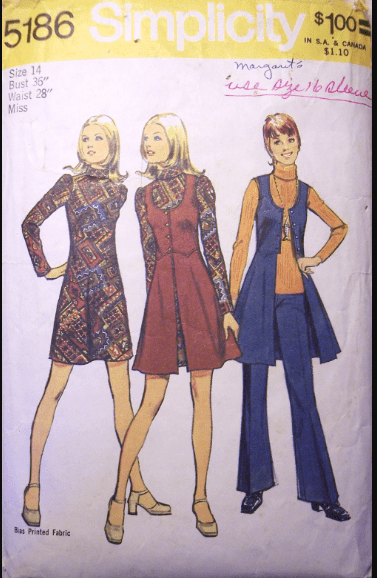
I was listing this super cute pattern in the shop this morning and saw that it touts “the new narrow shoulder look,” so of course I had to investigate. This pattern is from 1971. Simplicity must have been on the cutting edge of fashion at that point, because I find no references to the narrow shoulder look in newspapers of that year, nor of 1970. I do, however, see references in 1972.

Papers of that time defined the narrow shoulder look at having a shorter shoulder area as well as a higher sleeve head. It was also the fashion for mens’ jackets, with one article saying that this had been the fashion for men in the early 1950s as well. It’s not often in those days that you saw a collision of mens’ and womens’ fashion, unlike today with all of our unisex clothing.

Here are a couple of other examples of the narrow shoulder look. The combination of the short shoulder and the high sleeve head make the arms look longer, for a very flattering look.

Love the tailoring on the first one. It is super feminine and whittles the waist. The second one, 5186, is also called “the Navajo Look,” for reasons I will have to investigate.

Since the original pattern, 9446, is from 1971 and other two are in the 5000’s and 1972, I think the first one was likely an original pattern of the narrow shoulder style. I can see some of the Romeo & Juliet influence of the early 70s here, following the 1968 film by Franco Zeffirelli. The sleeves aren’t in true Juliet style like some patterns of the era, but they are definitely quite full — not unlike coming out of the leg o mutton sleeves of the 1890s and into the 1900s. Fashion echoes history as it changes.

I know that a lot of people take issue with puff type sleeves, and I don’t think I’d wear them now as I have gotten fluffier in my old age, but I used to love them back in the day. This style would not only elongate the arms but it would (obviously) narrow the shoulders — a big plus for someone with linebacker shoulders like me!

I’d make this in the shorter length. What do you think?

sewing

Blast from the Past

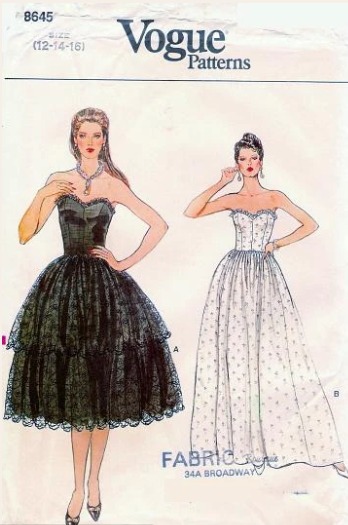
I came across this pattern in my stash, and immediately knew it was from 1986. How, you ask, did I know? Well, dear readers, it is because I wore an exact replica of this dress on formal night on a cruise in 1986.

I bought the dress at Penney’s, and accessorized with an onyx and rhinestone necklace with matching earrrings. I believe that this was the night that we sat at the captain’s table. In either event, we closed the night out at the disco, where I dance with the captain to none other than the Human League and Lisa Lisa and the Cult Jam (my nickname is Lisa Lisa to this day in certain circles).

That particular cruise will go down in history being noted as the first cruise I went on. We got to go for free, because my then-fiance-now-ex-husband won a contest as a McDonald’s manager and got the tickets as a reward. The managers were allowed to take someone with them, so I told his very single buddy that he was taking my best friend, who he had barely met. We girls shared a room, and the guys shared a room. Mostly they just did stupid things like constantly moving the plants in the hallway, at times putting them into their room, and finding that there were always replacements put out immediately. Where they kept all those plants was beyond me.

In either event, it was a three day cruise to the Bahamas, and other than the previously mentioned shenanigans, I don’t remember much because we were 22, fueled mostly by alcohol for those three days, and I’m pretty sure we never slept at all. Made for great memories which all came to light again when I saw this pattern. It was a great dress. I still have the jewelry. And honestly, I don’t think any cruise I’ve taken since has matched it as far as fun – and that’s saying a lot, because I’ve been on some great cruises.

sewing, sewing patterns

Home Ec

I took Home Economics in eighth grade. There were two semesters: cooking, followed by sewing. I only took the cooking semester, because there were boys in shop class, which meant I went off to wood shop for second semester. What a waste of my time.

I’ve always been interested in home economics classes as they pertain to sewing. I’ve come across a lot of home ec books over the course of time and have read the fascinating book The Lost Art of the Dress, which recounts the history of home ec classes and how the women involved influenced fashion. It’s interesting stuff, if that is the kind of thing that you, like me, nerd out over.

I came across a couple of books that talked about teaching sewing in schools and found the details interesting. They correlate quite a book with the aforementioned book’s timeline, in that sewing at home ebbed and flowed. The late forties were more of an ebb in home sewing, and the 1948 book I found said that in a study of a tenth-grade high school class, only one student had ever used a sewing pattern, only a third of the girls’ mothers sewed, and less than half of the classes’ homes had a sewing machine. That’s a lot of idle machines. Students started by learning to sew a simple gingham sewing bag which was used to hold supplies, and then gradually advanced to sewing garments.

An 1894 book by the Superintendent of the Philadelphia schools, it is noted that sewing began being taught in schools in 1880 and began to be a part of the regular curriculum five years later. Instruction began in third grade. The city provided supplies like pins, thread, thimbles, needles, scissors (regular and buttonhole), cotton for sewing and darning, dressmakers’ scales, emery bags, and paper for drafting patterns. One square foot of muslin was given to each student and was replenished as necessary. The city allotted six cents per student for these supplies.

Classes started in third grade with the most basic of principles: posture while sewing, and how to correctly position one’s hands. Right- and left-hand position were taught separately. Drills were in threading needles, taking a stitch and drawing through fabric, and how to hold scissors. Sewing instruction began with turning the hem, basting and then sewing the hem. Frequently these skills were taught using paper first, instead of fabric. They then learning how to overseam on turned edges, and how to cut a straight line. If students were successful in straight cutting, they were allowed to bring towels and washrags from home to practice hemming.

Second semester of third grade taught back stitch, running seam, half back stitch seam, raw edges of seams to be overcast, hemming of towels, napkins and desk covers. Actual sewing began this semester, with creation of sewing bags, pillowcases, oversleeves, iron holders and bibs. The most amazing thing to me is that in this semester, third grade, with a bunch of eight and nine year olds, they began teaching pattern drafting, by creating patterns for bibs and simple waists (blouses) with straps over the armholes. Most home sewists today don’t know how to draft patterns, and they were teaching babies! Amazing.

In fourth grade, reversible seams were taught, as well as square patches. Hemming of tablecloths and sheets were done, and pillowcases, dust caps, pen wipes and other little projects were sewn. At this point, students were taught how to sew on a four holed button. Drafting projects included yokes, under waists with seam over the arm, and book covers. Second semester, students learned gathering and darning, made plain aprons and book covers, and learned to sew buttons on shoes and basic mending. Drafting projects included under waists with under arm and shoulder seams, aprons, children’s and baby dresses.

Fifth grade lessons were done in narrow hems and fells (flatting the seam, turning it and then sewing it down), tucks and fine gathering, darning, French fells, angular patches, and buttonholes. Sewing projects were drawers, combing capes, shoe and stocking bags, aprons, under waists and plain skirts. Drafting of drawers and under waists with one dart and with spring (curve) to fit the hip were taught.

Sixth grade paid attention to buttonholes, and also taught round patches, herringbone and feather stitches, gusset and bias seams. By this time, girls learned to make chemises, blouse waists, night shirts and flannel skirts. They drafted chemises, gored skirts, dress sleeves, night shirts and blouse waists. Seventh grade taught French gathering, tailored buttonholes, cutting and fitting of plain garments like night dresses, corset covers, and men’s shirts. Patterns were drafted for these garments.

Eighth grade found students cutting, fitting and sewing garments of all kinds, with special attention to men’s shirts and garments that fit the students. Drafting was done for dress waists, sleeves and skirts.

The Philadelphia school system employed 41 sewing teachers to instruct 58,000 students in these skills. They really invested in the program, and the girls, by the time they graduated eighth grade, would have learned all the basic skills to draft patterns and sew their own wardrobe, as well as for family members. Keep in mind that this was also all hand sewing! Amazing, isn’t it?

designers, sewing, sewing patterns, vintage clothing, vintage fashion

Van Martin and Being a Creator

McCalls 7575, ©1981,

A new listing in the Etsy shop: this track suit style jacket by McCall’s, labelled Van Martin. It’s from 1981, when track suits were starting to become a bit more stylish. The pattern is only for the jacket though. It looks comfortable, because it has an inverted pleat down the back, to give you room to move, and you can make it with anything from poplin and linen to double knits and velour. It’s pretty versatile (and this one is a bust 40, which is nice for today’s ladies).

Van Martin was a sportswear designer. I like what he had to say in this article from the White Plains Journal-News. He said [sewing] “is a means of expressing my creativity. When you cook a meal, you create something that’s never before existed, and that’s what you do with sewing.” Isn’t that cool? You may buy a pattern, even a pattern that’s existed and been owned by various people for a hundred years, but you still are creating something that’s never existed before, because you are choosing the fabric, buttons, zippers, trims all yourself and making it your own. You are a creator. I love the existentialistic idea of that.

Deep thought for a Monday, isn’t it?

1970s fashion, sewing, sewing patterns, vintage clothing, vintage fashion

The McCall’s Sew For Fun Series

/ 442+

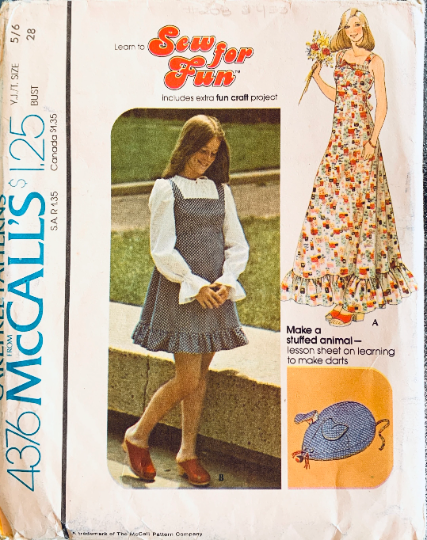
McCall’s 4376, ©1974

I listed this pattern the other day in the Etsy shop. I’d never seen this series before. It’s called the Sew for Fun series, and the patterns came out in 1974 and early 1975. The styles are the cute boho/cottagecore patterns so popular in the time. This one features a maxi dress with Gunne Sax vibes. It can be made in the shorter mini length as well.

Note: I had a pair of clogs exactly like the ones in the photo.

The patterns featured mainly dresses and tops, are were made in both Miss and Misses’ sizes, with different pattern numbers for each. There are at least two that are unisex: one is a top and the other is for a swimsuit/swim trunks. But the funny thing is those little extra patterns.

This particular one features a stuffed mouse, because every cottagecore girl of the seventies wanted a stuffed mouse, right? I thought at first that it was a pincushion, which obviously any sewist could use. And a young beginning sewist might be pleased to create her own personalized mouse pincushion, right? Only it’s not. It’s a stuffed animal, which seems a little odd paired with the cute dress. But it gets weirder.

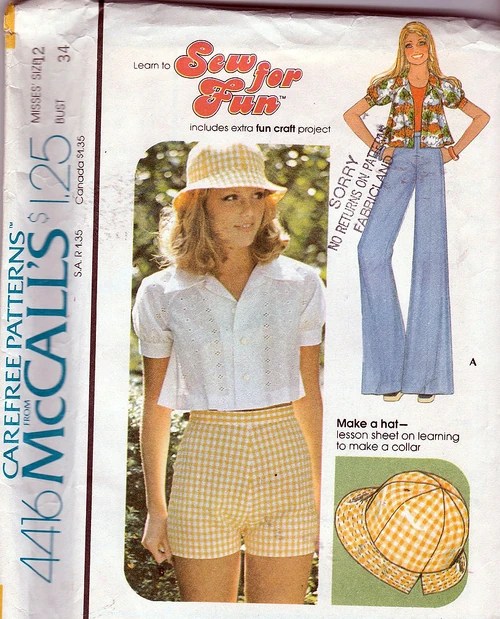
McCalls 4416, ©1975. Photo: Vintage Pattern Wiki

Some of these patterns are paired with hats or purses, which makes sense to me. Hats were big in this era, and everyone can use a sun hat. Purses are also a no-brainer. But there are also odd items like garment bags, a wind breaker (for sitting on at the beach, not the jacket), and even a tent. Each of them has a little sewing lesson with it, which is great, but the projects they include are so weird. Like the wind breaker one. If you want to teach someone to make a casing, have them make a pair of elastic waist shorts. But I don’t make those decisions.

McCalls 4429, ©1975. Photo: Vintage Pattern Wiki

I wonder who came up with these little extras, cause they just seem so odd. I get that they were trying to make sewing fun, especially for the Miss crowd, but somehow I am not sure that they thought it all the way thru. It’s one of the more random ideas put out by the sewing pattern companies.

McCalls 4428, ©1975. Photo: Vintage Pattern Wiki
sewing, sewing patterns

1935 Spring Wardrobe

I found an article from 1935 that mentioned what a woman’s spring wardrobe should be, so I went looking for the patterns. I couldn’t find a lot of them, so if you see any of them, please share and I will update the post. Listed are the patterns, the fabric recommended, and the final price to make it.

Swagger Coat Advance 1275 – El Chico Waffle Cloth – $1.23

Sports Ensemble Advance 1160-2 – Hollywood Yarn Dyed Seersucker – $2.82

Shirtwaist Dress McCall 8327 – Penney’s Printed Cord Fabric Pic-Pon – $1.71

Lace Knit Frock – Advance 1232 – Lace Voile $1.40

Afternoon Dress – Advance 1047 – Hollywood Printed Voile- $1.40

All Purpose Frock – Advance 1128 – Lace Voile – $1.35

Evening Dress – Advance 1138 or 1162 – Novelty Silk Crepe $4.27

All Day Frock Advance 1201- Cotton Sheers – $1.19

Eton Ensemble – Hollywood Polo Check – McCall 8328 $1.74

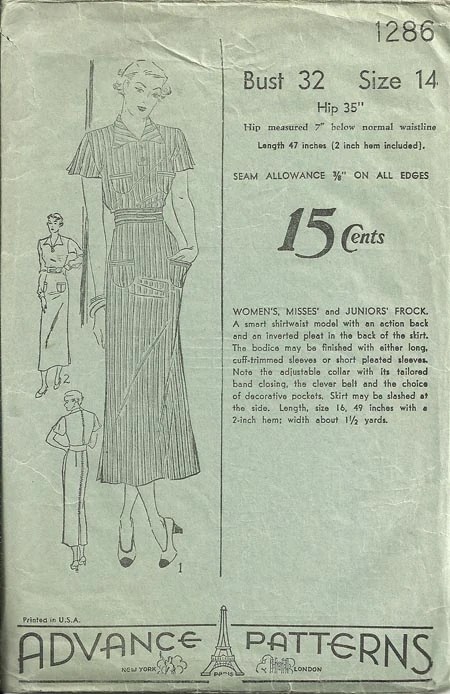
Daytime Frock – Advance 1286 – Rondo Fabrics – $0.87

An entire wardrobe from JC Penney’s for $17.98! That’s just amazing to me.

sewing

I Have Questions.

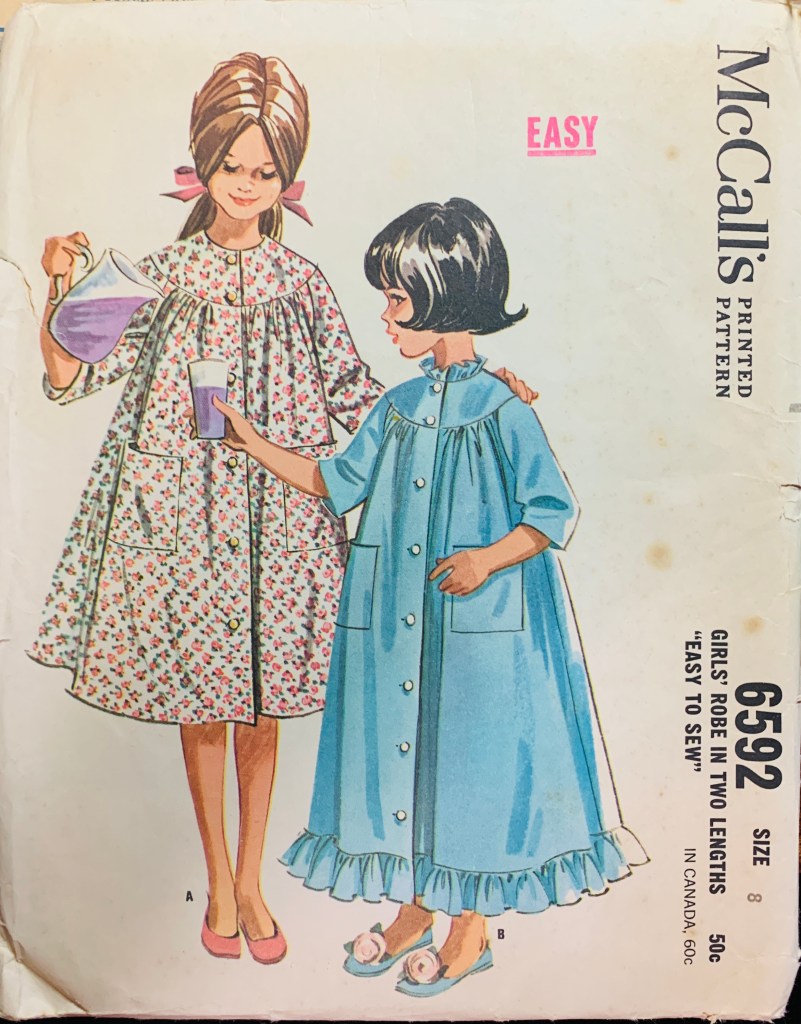
McCalls 6592, ©1962

I love this little blue robe. I’d trim it in eyelet, because I just love eyelet. That being said, the shorter version is cute too, isn’t it?

My first question is about the pocket placement. It seems high, especially on the blue one. I think that the way it’s cut means that they need to be placed high, but doesn’t it look a bit wonky?

My other question is, what the heck is that girl pouring? Purple Kool-Aid? Was it a Netflix and chill day, or was she giving Sissy Kool-Aid for breakfast? Is it some weird science experiment? I need to know.