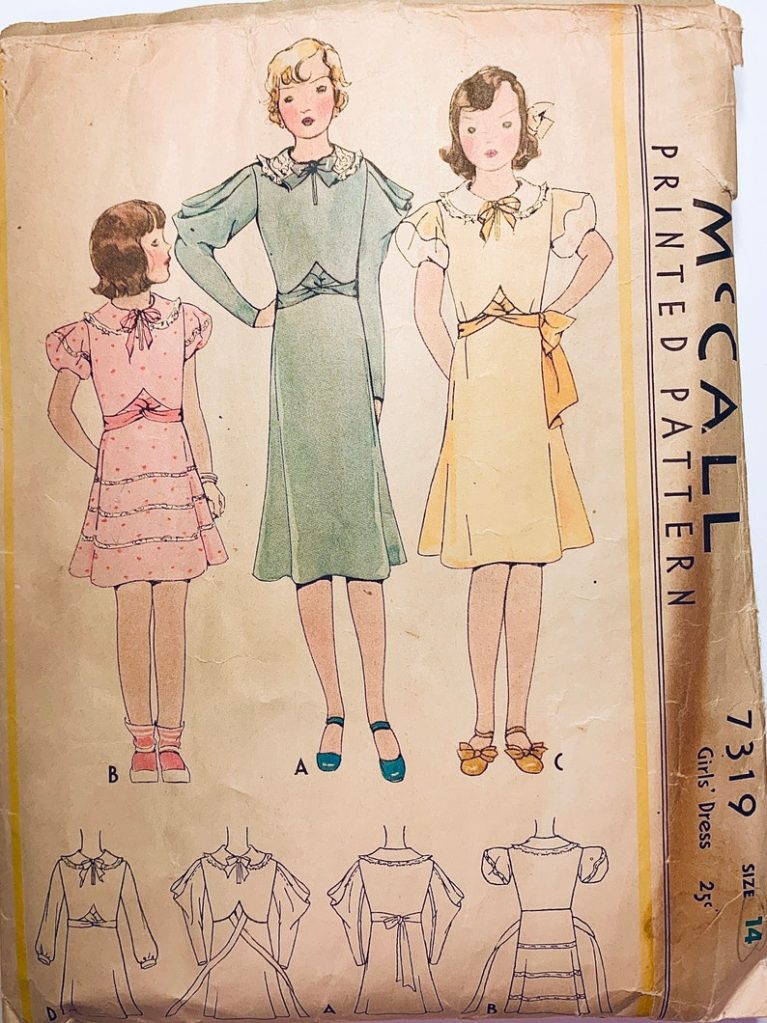
Look at the mastery of details here, in not only the garment, but the illustration itself. This pattern shows why the 1930s were so spectacular. That little twisted belt effect at the waist. Those cowl sleeves on the middle version. Even the little detail on the puff sleeve is a simple but perfect detail to make this dress special.
You won’t see dresses like this in Target. The cost of putting those details in is prohibitive in today’s disposable, fast-fashion society, and it’s a shame. This dress would take a child from Easter, to springtime tea, to summer weddings, and straight into Christmas (though you might have to size up. Kids grow, after all).
Add the details of the illustration, and I’m really in love. The little shoes. The slouchy socks. This era of McCalls patterns are the ones that, if I were having babies today, I would frame and put on a nursery wall. They are just so delicately beautiful. What do you think?
I listed this pattern in the shop the other day. I’ve had it before, and it always screams out to me that I need it. Badly. That one on the left is gorgeous. That ribbon trim just slays.
It’s an interesting pattern that isn’t difficult to make. The sides have shirring to help create a waistline, and the shoulders don’t have a seam — they are just part of the fabric that is draped to create a sleeve. Very clever. It’s not even described as a caftan. It’s described as a robe. It reminds me in some ways of one of my favorite movie costumes: Katherine’ Hepburn’s robe in Philadelphia Story. It was designed by Adrian, and I love it, primarily because of the sleeves and the draping. Look at the clever way the waist and the back are done.
::sigh:: Glorious. I, like Balenciaga, have a real thing about interesting sleeves. But can you just imagine gliding into the kitchen in the morning, wearing either of these robes? Yes, of course they would fall into my oatmeal or I’d spill my beverage down the front of me, but I’d look wonderful before all that happened.
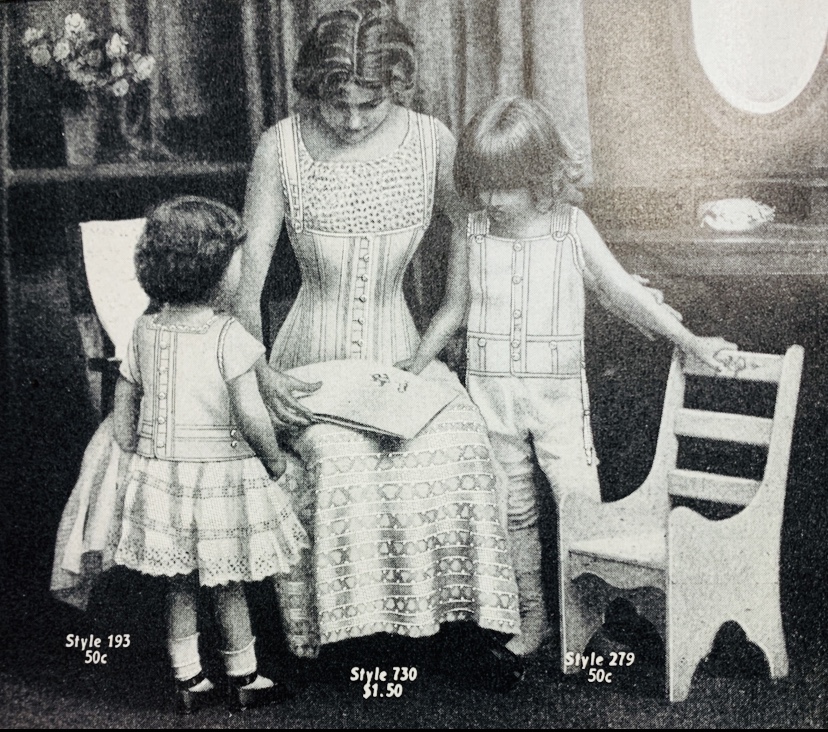
I came across this ad for Ferris Corsets in a 1913 newspaper, and it stopped me in my tracks. It reminds me of this scene in Titanic, where Rose realizes how trapped she is in a proper life (the sound is terrible, but it’s the visual that matters).
I’ve never forgotten that scene, in part because the costumes are so beautiful, and also because you don’t generally see children’s costumes in period dramas like you do adults. The biggest reason it stuck with me, however, is because it shows just how young girls were when this staunch, rigid training started. And yes, training corsets were a part of it. Women didn’t just start wearing corsets one day — they wore training ones to get them used to them as children.
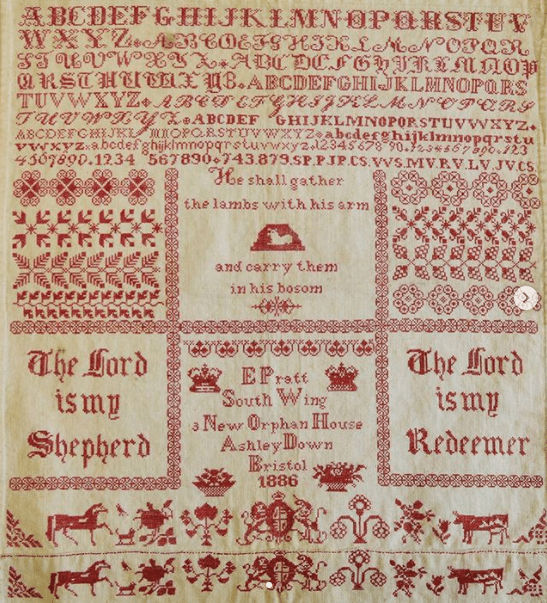
I can imagine it would’ve helped me tremendously to wear a corset as a child, because my posture is absolutely abysmal — likely the worst you might ever encounter. I slouch like no other. But I can’t imagine playing as a child while wearing a corset. Granted, these are training corsets, so they aren’t tight laced, but still. And boys had no equivalent. They likely didn’t have the same level of training either, for what is proper, because girls had to learn stitchery and the like from an early age as well. Look at this beautiful sampler in redwork, done by a child at an “orphan house” in 1886. It’s lovely, but the fact that she was an orphan makes me so sad. What did her future become?
Photo: Kate Strasdin, Instagram.
It’s simply lovely. Girls learned such intricate skills at such an early age. I hope that we never lose these artists, but I fear that we are, especially since Home Ec doesn’t really exist much anymore. That’s why I love sewing patterns so much. I love being a part of keeping the needle arts alive.
I’m rambling, I know, but we’re having a huge snowstorm and perhaps it is making me think harder — I love winter so much. The snow makes me feel alive in a way nothing else does. But I’ll say this: I won’t be shovelling snow in a corset!
I came across this pattern in my stash yesterday and thought “wow, what a cute dress.” Except, it’s not. It’s an apron and a coverall. Very stylish, isn’t it? It does a back wrap, then comes around and buttons in the front. I’m not sure that those huge triangular pockets would be helpful, because everything would fall out of them, but isn’t this a chic look?
The coverall is designed to wear over your frock whilst you clean, so your day dress stays fresh. It’s basically designed in the same vein as a Claire McCardell popover dress, which was meant for the same task. The earliest ones came with a matching potholder, and the popover was a staple in Claire McCardell collections.
Photo Credit: Michaelzee.com
Claire McCardell is one of my favorites, because she basically birthed American sportswear. She created comfortable fashion that was also stylish. Her use of plaids was also really beautiful. Not red carpet glam stuff, most of it, but comfortable day wear. She died at 52 of cancer, which was far, far too young. I would’ve loved to see what she would’ve done had she lived longer.
I came across this interview with Claire’s brother, which I found super interesting. Given the fact that she skiied so much, and that she was on the first board of Sports Illustrated, I always thought she must’ve been a talented athlete. Not so. Who’da thunk?
This is what one would call a lesson in patience. This unique pillows take a lot of work. View 1 (blue) is constructed of 165 petals, cut from 3 different shades of 2 inch wide blanket binding. View 2 (white) is also 165 petals, but is made from net or tulle — the thought of that much netting makes my blood run cold. View 3 (pink) is probably the most palatable one for my patience level, with 12 rows of 5/8″ wide lace edging.
Thankfully, the backs of these are plain, though perhaps some saint would make both sides the same. That person would not be me. What about you? Do you have the patience for this?
I listed this Seventeen Magazine on eBay today. It’s from March, 1975, so I would’ve been thirteen (don’t judge). It’s full of interesting stuff, like an article on a young Ron Howard, and even has a Wella Balsam ad with pre-famous Farrah Fawcett in it. Good stuff.
But the thing I found interesting was the article they had about how to become a model. I’ve read the requirements from the 50s, but expected the seventies to be perhaps a bit more lenient. Alas, I was wrong. The article interviewed a recruiter who said that first, she made sure that the person was eligible, meaning that they met the height and weight requirements. What were they, you ask?
Models of the era had to be at least 5 foot 7, which is probably still fairly accurate. I think they prefer them to be at least 5 foot 9 now, but some smaller models have made it through (I’m looking at you, Kate Moss). It’s the weight that threw me for a loop: they had to be between 100 and 118 pounds.
100 and 118 pounds. On someone who is at least 5 foot 7. That makes her BMI come to between 15 and 18%, which is very underweight these days. Now, I get that people were much smaller then. I get that most models are kind of genetic unicorns who are born with a lithe, tiny body, but really? That’s what they encouraged? Add to this that this article was contained in the same issue that contained an article about anorexia and how it can be fatal.
I was really surprised. I get that sizing now is completely different than it was years back, and that bodies were generally smaller, but that would’ve been TINY even then. My sisters were tiny and they both weighed 95-100 lbs when they got married. They were 5 foot 1. My mom weighed 95 pounds when she married in 1953, and at 5 foot 6, her nickname was bones. I never really pictured models to be that thin until Kate Moss came along with her heroin chic look.
Are you surprised? And are you surprised that we still are only just starting to touch on the possibility of having normal sized people on the runway? Let’s do better, people.
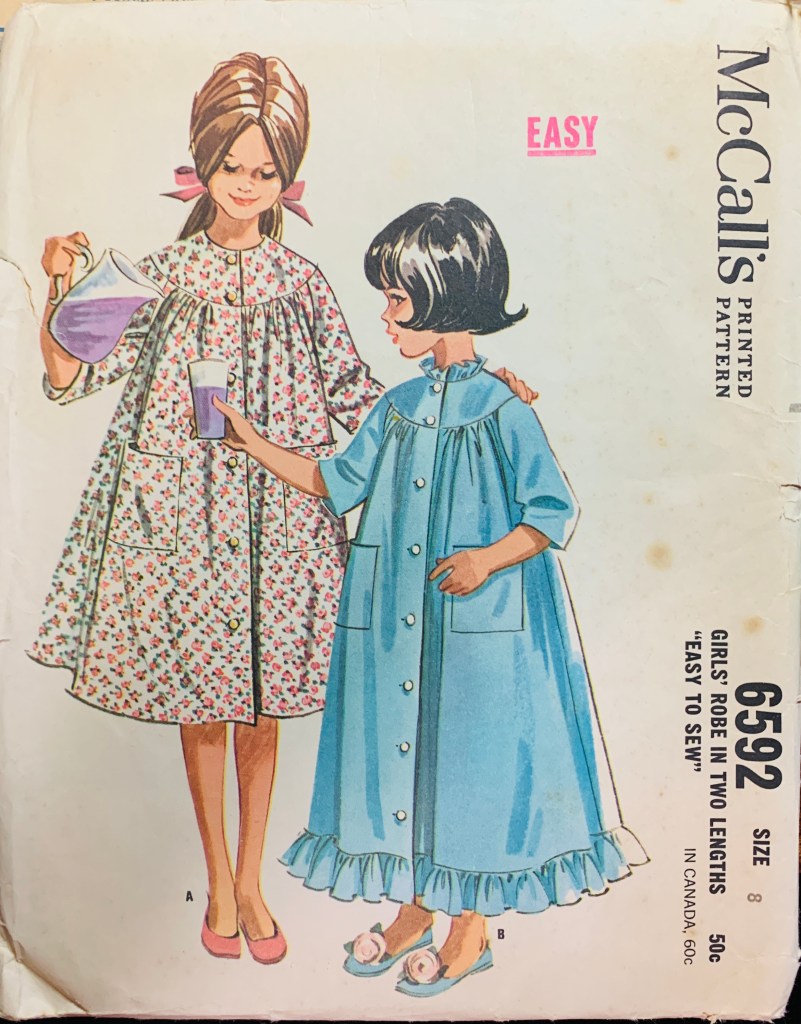
I love this little blue robe. I’d trim it in eyelet, because I just love eyelet. That being said, the shorter version is cute too, isn’t it?
My first question is about the pocket placement. It seems high, especially on the blue one. I think that the way it’s cut means that they need to be placed high, but doesn’t it look a bit wonky?
My other question is, what the heck is that girl pouring? Purple Kool-Aid? Was it a Netflix and chill day, or was she giving Sissy Kool-Aid for breakfast? Is it some weird science experiment? I need to know.
I came across this whilst trying to date another pattern for collar, cuffs and vests from the same time period. I find it fascinating.
May Manton 8462, 1914.
I thought at first that the “vest” is a different garment, but it’s not. It’s attached, and only gives a vest effect. A faux-vest, if you will. I like it in theory, and it’s interesting to look at, especially with the contrasting fabrics, but I think in reality it wouldn’t lay right when you sit, and would probably bunch up at the waist. What do you think?
Description in the ad: “Here is a blouse which shows distinctly new features. It is quite simple and severe enough to be made of linen or pique and is well adapted to the various tub silks and to combinations of materials. Since the washable silks launder quite as well as cotton and linen, it is easy to combine them and the combination is extremely handsome. In the illustration, striped tub silk is made with vest, collar and cuffs of pique but in the back view, white linen is combined with colored. The long plain sleeves are exceedingly fashionable but, in spite of that fact, many women prefer the shorter length and these can be cut off as shown in the back view. There is just fullness enough in the blouse to be becoming while the plain stitched vest gives a tailored finish.”
I have so many questions. First, combining linen and silk when laundering would be a nightmare, yes? Add colors and whites together and how in the world did they make this happen? What kind of laundry wizardry was involved here?
Mom passed on December 6th, at home, surrounded by her family. More about that later, when I’ve had time to process it better, but this. This picture shows a good depiction at where I’m at right now.
After Mom died, we emptied her apartment into my house and garage. She was not sentimental about things, and they moved so much that she purged belongings on a regular basis, so although it was a two bedroom apartment, it wasn’t as much stuff as it could have been. That being said, it was a LOT. It completely takes over half of our garage, and spilled into our sunroom and my office. It was chaos, more than usual.
I started slowly, because trying to sort through stuff during a period of fresh grief is hard. I had my boys put all the media stuff into the office. My dad was a communications and electronics guy. There were probably a couple of hundred 8mm home movies and video tapes to go through, as well as videos that hadn’t been copied from the camcorder tape, cassettes, photos, slides, and on and on and on. I ordered two boxes from Legacybox, and am having the family stuff digitized, so everyone has a copy. There’s nowhere in Indiana to recycle VCR tapes, so I ordered a box from Green Disk and have it nearly full. You can almost walk in the office now without fear of losing a limb — note I said almost. Hubby still won’t go in there.
We switched out TVs and took Mom’s new smart TV — that ended up being something of a pain, because we couldn’t get the internet to work on it for a while, despite my tech support son’s hard work. Next day, I googled it and got resolution to the problem, but we still have the old TV and stand in the sunroom. Baby steps.
I’ve passed along some things through our local FB Buy Nothing group. If you haven’t indulged in this group, it’s a great way to get rid of stuff that someone else may need. You can also get stuff there, or even borrow. The only catch is that it absolutely must be free. I gave away Dad’s shower chair, two walkers, their microwave, and some odds and ends. It was nice to be able to bless people in their season of need. I very rarely use it to get things, but it’s great for giving stuff away.
And so, on to this picture. This is my computer “tower”. It is in what I’m calling her “my” office, but it’s actually my husband’s office that he doesn’t use. (Mine is chock full of sewing patterns.) This area was piled as high as the printer with stuff. It really only took me about half an hour to process the stuff, but meantime, I found a pattern I had misplaced that someone was interested in, as well as the forms I filled out last year, fighting with the post office over a package that arrived empty in the buyers’ mailbox (if you live in Ohio, there’s a 1940s corset floating around there in a post office). Some stuff got moved to a different pile to be filed, but for the most part, everything is taken care of.
I needed this today. After the last few months and all of the life and death crises I’ve dealt with, I needed a clean space. Yes, that’s a bobblehead Pope Francis. No, I’m not Catholic. He just makes me happy. The jar of pins behind him is a collection of pins that I started last year, harvested as I count pattern pieces. It makes me happy too — I feel connected to the original owners of my vintage patterns.
So yes, I’m going into Christmas with a clean slate, no matter how small it is, but it gives me peace and is helping to keep me sane, even while I have an undecorated Christmas tree up and nothing wrapped.
Here’s hoping that you find peace in the holiday season as well. Next, I will tell you about my plans for the new year.






 The Vintage Fashion Librarian