1920s fashion, 1950s fashion, sewing, sewing patterns, vintage clothing, vintage fashion

The Spectator Dress

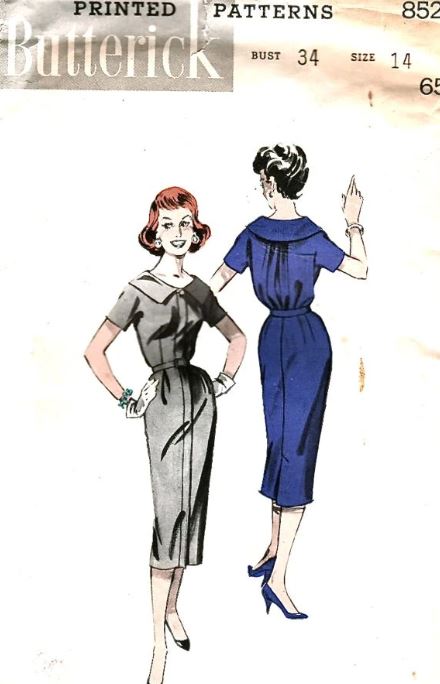
I’m working on adding this chic beauty to the website. They call it a Spectator Dress, so of course, I went digging, as that’s not a term I’ve heard before. Two toned specator shoes, yes. Dress? Not so much.

Turns out that it’s a term for a shirtwaist dress. It is first seen in 1927, as a dress to be worn while watching tennis, polo or golf. The term is seen all the way through World War II and beyond, into the 2000s. Styles vary. It might be seen as a a super simple linen sheath, perhaps with pockets, or it can also have some oomph, like silks with added French cuffs or a tucked bodice. This one has two special accents: a bloused back, which I’m not sure works that well. I think it may give a broad shouldered person a bit more room to move, but I would have to be convinced that it wouldn’t look poufy and look like a hump back there. I do love the collar though. It also has a hidden zipper front, so it’s easy to get on and off, which I am always a fan of.

What do you think?

1950s fashion, designers, sewing, sewing patterns, vintage clothing, vintage fashion

Designers Hiding in Plain Sight

I was trying to put a date on a Bestway pattern that I recently received, and came across this. Bestway Patterns are British, and the numbering is odd. In the thirties, they seem to have five digit numbers, but it evolved to a lettering and puncuation system later. The one I have is C. 1,019, so it must be around this era. You also have to take into account the years of wartime fabric rationing in Europe, which were much longer than in the US, and much more strict.

The pattern I have is a shirtwaist dress with pleated bodice and skirt, and falls below mid knee. The hairstyle is similar to this one, so it can’t be thirties, and since fabric rationing was throughout the forties in the UK, I figured it was, at earliest, 1950. That’s how I found this one.

This dress ad is dated March of 1950, from a Liverpool newspaper, and as you can see, is plainly noted as a Christian Dior style. Not only that, it is advertised as the first Christian Dior pattern made available to the public, three years after his first collection was seen on the runway. It is not, however, labelled as such anywhere on the envelope. This is how much you have to dig sometimes to realize that it is a designer pattern. There is a set of McCalls patterns from the sixties that are Biba, but not openly marked as such as well. It’s well worth it to see exactly what you may have. The pattern companies did not always make is simple.

1930's fashion, sewing, vintage clothing, vintage fashion

I’ll Fly Away (on Fabulous Friday)

I was listing this 1935 Excella catalog in the Etsy shop, and I fell in love with this. The one on the left. The one with the collar that could be mistaken for wings. The Dumbo of dresses, if you will. Isn’t it amazing?

The seams. The buttons. The topstitching. Everything combines to make it a memorable garment to enter a room in. This is why I love the 30s so much. It hugs the curves but can stand alone in it’s style. You wouldn’t even need much in the way of accessories for this look to sing. And lest you think that that collar would indeed take flight — NO. The topstitching would help it stay in place just fine.

It’s Friday. I’m in love.

1930's fashion, sewing, sewing patterns, vintage fashion

Irresponsible Fashion

I got this 1931 McCall Quarterly catalog recently. When I was listing it in the Etsy shop today, I came across this article, and it made me smile.

“Sports frocks are somewhat uniform in style. Street dresses have many characteristics in common. But the afternoon costume is another story.

In fact, the formal day mode is varied to the point of appearing irresponsible. But there is really a chic purpose behind each of its moods.

The three models that you see on the right were created for early afternoon hours. and underemonious events. Their formality hints of the casual…in simplicity of lines…fabrics taht are not too elegant…skirts that clear the floor by about ten inches.

For later hours and more formal occasions, designs become a little more feminine, fabrics a ilttle more elegant and skirts quite a bit longer. Sleeves may be either long or short. For a change you may prefer the full-length sleeve in the same from with an ankle length skirt. This combination has a provocative new look about it. “

They go on to talk about choosing accessories: gloves long enough to wrinkle at the wrist, and purses chosen as ornamental, not utilitarian.

It’s funny to look at this with today’s eyes, as we would likely never consider these beautiful garments to be irresponsible or even anything but elegant. But then again, today’s sportswear is anything but elegant, and thinking of an afternoon dress has likely never occurred to the majority of the population. I love this insight into the psychology of fashion in the 30s. It’s one of the reasons I love studying fashion so much, and why, as Miranda Priestley so eloquently put, it’s not just a blue sweater.

1970s fashion, sewing, sewing patterns, vintage fashion

The Narrow Shoulder Look

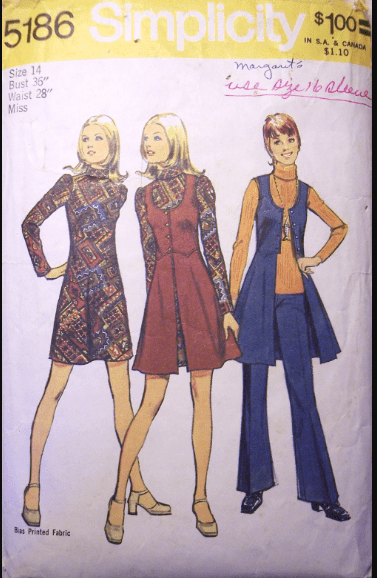
I was listing this super cute pattern in the shop this morning and saw that it touts “the new narrow shoulder look,” so of course I had to investigate. This pattern is from 1971. Simplicity must have been on the cutting edge of fashion at that point, because I find no references to the narrow shoulder look in newspapers of that year, nor of 1970. I do, however, see references in 1972.

Papers of that time defined the narrow shoulder look at having a shorter shoulder area as well as a higher sleeve head. It was also the fashion for mens’ jackets, with one article saying that this had been the fashion for men in the early 1950s as well. It’s not often in those days that you saw a collision of mens’ and womens’ fashion, unlike today with all of our unisex clothing.

Here are a couple of other examples of the narrow shoulder look. The combination of the short shoulder and the high sleeve head make the arms look longer, for a very flattering look.

Love the tailoring on the first one. It is super feminine and whittles the waist. The second one, 5186, is also called “the Navajo Look,” for reasons I will have to investigate.

Since the original pattern, 9446, is from 1971 and other two are in the 5000’s and 1972, I think the first one was likely an original pattern of the narrow shoulder style. I can see some of the Romeo & Juliet influence of the early 70s here, following the 1968 film by Franco Zeffirelli. The sleeves aren’t in true Juliet style like some patterns of the era, but they are definitely quite full — not unlike coming out of the leg o mutton sleeves of the 1890s and into the 1900s. Fashion echoes history as it changes.

I know that a lot of people take issue with puff type sleeves, and I don’t think I’d wear them now as I have gotten fluffier in my old age, but I used to love them back in the day. This style would not only elongate the arms but it would (obviously) narrow the shoulders — a big plus for someone with linebacker shoulders like me!

I’d make this in the shorter length. What do you think?

sewing, sewing patterns, vintage clothing, vintage fashion, Vintage Kids

Frugality at Its Best

Advance 4442, ©1947.

I love this pattern. Vintage boys’ patterns often go overlooked, in part because, like mens’ patterns, there just doesn’t seem to have been as many printed. The looks are a bit more dated that in little girls’ styles, but they are so cute. What makes this one special though, is that the coat is constructed from a man’s suit. It’s upcycling, before it was cool.

It’s from 1947, so it’s post World War II, where the US was beyond fabric rationing (which didn’t apply to home sewing anyway). Businesses were starting to thrive after the war, so many families could afford a new coat, but apparently the frugality of the war extended to the years afterward. Remember, these moms were raised in the Depression era, and many remained frugal their entire lives, so it’s not surprising that they were using fabric they had on hand to construct new garments.

These days, a lot of sewists get their fabric from thrift stores, especially using vintage sheets in all sorts of patterns. Have you ever thought of repurposing a man’s suit into something new? I have this ebook in the store on how to mend mens’ suits, and of course you can buy this particular pattern in the webstore. I’ll have to do a bit of digging but I think I have a woman’s suit pattern made from a man’s suit as well, though I think it is included in one of my books. Have you ever upcycled a man’s suit? What did you make? I’d love to hear about it in the comments.

1950s fashion, designers, sewing patterns, vintage clothing, vintage fashion

Echoes of the New Look

Christian Dior rocked the fashion scene with his 1947, which was ultimately called “The New Look.” Gone was the fabric rationing of the era. The pronouncement that Paris fashion had not only survived the war, but that it was back in new and exciting ways was obvious, as Dior showed his “Corolle” and “Figure 8” styles. These styles were minimalist while over the top, with voluminous skirts, requiring yards of fabric never seen before. He stripped down to the details when showing them, keeping colors deliberately muted and hats very simple. The Bar Jacket is iconic, and seen in museums all overthe world.

Bar Suit, 1947. Photo: Vogue.

Echoes of the Bar Suit are seen throughout the late forties, fifties, and early sixties. It returns in the 80s, and is seen even today. Sewing patterns are reflective of its popularity. Remember, this is a time when sewing pattern companies and fashion designers sent representatives to Paris with their only assignment being to replicate the styles seen in the fashion shows. This brought Paris fashion to housewives in America, making real style attainable. As I’ve mentioned in previous posts, designers were not always given attribution, so it would take some deep diving to find which designer matched with which “Paris Fashion” pattern, but they definitely exist.

When I saw this pattern the other day, I saw the echoes, with it’s tiny “flap” (they don’t call it a peplum). It’s a one piece dress, as opposed to the Bar Suit, which is two pieces, but wouldn’t you agree that there is a definite influence here?

Marian Martin 9133, ©1950.

It’s not exact, of course, but it’s like hearing echoes of one musician in another’s music. The influence is definitely there.

sewing, sewing patterns, vintage clothing, vintage fashion

The Ultimate UFO

You, like me, may have some UFOs around your house. UFO, in our world, means “unfinished object”, and I have several. I have a crewel embroidery pillow that I’ve been working on. I don’t even like crewel embroidery, but I found this vintage crewel kit that features a bunch of different flowers. Since my mom loved flowers, and my dad did crewel embroidery until shortly before his death at age 92, I decided it might be a nice tribute, so I started it. But again, I hate crewel embroidery. Hate doing it, hate how it looks, so I don’t know if I will ever finish it. I also have not one but two embroidered baby quilts that I started but haven’t finished, because it flares my tendonitis and I decided that my daughter likely wouldn’t like them anyway. I guess unless my boys have kids one day, I will likely never revisit them, and even if they do, I still will probably leave them as UFOs.

A lot, if not most, of crafters/sewists have at least one UFO in their space. So imagine when I came across this. This is truly the ultimate in UFOs — 1740s silk that was cut into a dress. It was a mystery, and these women unravelled it. Here’s the short version:

Fascinating, yes? Well let me tell you, it’s even more so when you read the long version. Amazing, yes? That those pieces survived in a bag for almost three hundred years, all while being made into three different garments along the way. Perhaps in the year 2300, someone will find my baby quilts and finish them. It’ll stil be earlier than I’d get them done.

Celebrity, designers, family stories, vintage clothing, vintage fashion

Oscars Season

Oscars night is a big deal around here. I call it Pretty Dress Night, and my husband has zero chance of watching anything else as I enjoy the parade of fashion. It’s been this way for years.

When my now adult son was six, he had strep throat on Oscars night. We knew he wasn’t going to be going to school the next day and, being a huge movie fan even at that age, he begged to stay up to watch the Oscars. I think that Harrison Ford was going to be presenting one of the last awards, and he wanted to see him, so I relented. Since that time, it’s been tradition for us to watch them “together.” I have quotation marks because when he went to college, we were on AOL Instant Messager during the awards, and now we might get together, or we might be texting the whole time, but we always watch them together in one form or another. To say that he is a huge film buff would be a gross understatement.

Around the time of the first Oscars we watched together, our video store had a contest for choosing the winners. I got stuck waiting in line and just dashed off my guesses and put them in the box. I won. I got ten free rentals, which the ex used. That was fine, because I didn’t watch a ton of movies — I was working evenings and home schooling three kids during the day. The ex, on the other hand, always tried to see the Oscar nominated films. He couldn’t believe that I won, given my lack of film viewing, so the next year, he brought me the ballot from the video store and challenged me to beat him. I did. And I won another twenty movie rentals, which he again used. Now he was unhappy, because he went to the time and expense to watch all these movies, and I may see one Oscar nominated film a year. So he did it again the third year in a row, and I won again. Twenty movie rentals, but now the video store required showing ID in order to get the free rentals, so he couldn’t get them.

He swore that I told them not to rent the movies to him. I didn’t. I think we eventually used them up, but after that, he refused to compete with me. My oldest, however, did not. It was ON. Year after year, he tried to beat me and failed. Finally, maybe four or five years ago, he finally beat me. I don’t pay as much attention to the buzz as I used to, but now all of the kids and I have a running contest to see who guesses the most accurately. We usually come in pretty close. But really, I’m just there for the clothes.

It’s funny to think that the Oscars weren’t a huge event when they started, and have only gotten huge since the seventies or so. Now, it’s the red carpet night, arguably even bigger than the Met Gala, which is only watched by fashion fans. Oscars night is seen by anyone who loves movies, so its reach is massive. This is huge for the designers who want to get their designs out there. I listed the book shown above in the Etsy shop the other day. It’s a great view of the Oscars up to the early 2000s, and has tons of photos, black and white and in color, of the stars of the day. Meantime, I’ll be on the couch with popcorn, passing judgement on the stars on Oscars night. Who’s gonna join me?

1970s fashion, designers, sewing, sewing patterns, vintage clothing, vintage fashion

Vogue French Boutique

I listed this pattern in the Etsy shop today. I’d never seen a Vogue French Boutique pattern before.

The French Boutique series seems to have been a shorter lived series that was distributed between about 1976 and 1981. Most of them are designed by Christian Aujard, though Renata has a couple as well. These were lesser well known boutique designers in Paris at the time. Renata, the designer of this one, was known for creating loose, comfortable styles.

I love this one. I’d wear the blue version with boots. It looks unbelievably comfortable, doesn’t it? I think you could get through Thanksgiving with this style and never feel the need to loosen anything after the feast. The top would be great with jeans, but would work with loungewear pants as well. I do prefer the belted version though — unbelted, it reads maternity.

I’m going to be keeping my eye out for not only more French Boutique patterns, but also Renata. Her aesthetic reads as contemporary even today.