1970s fashion, sewing patterns, vintage clothing, vintage fashion

Where I’ve Been, and Other Stuff

It’s been a while, and I apologize. Life took a huge shift as our world tilted on its axis a bit. We went to Michigan for the weekend on June 2nd, and it turned into a twelve day (mis)adventure.

We originally went to inter my parents at the Great Lakes National Cemetery in Holly, Michigan. It’s a beautiful place, and though I’d never seen it before that day, I understand now why my parents chose to be interred there, rather than closer to one of their kids’ homes. It is simply gorgeous. The place where they are is next to a farm field, and you can hear trains going by regularly — two things my parents loved. My daughter found a great house for us to rent in Holly, where our whole immediate family could stay, as well as my brother’s kids. To say that the house is gorgeous is an understatement. Though I ended up not spending as much time there as I had hoped (more in a minute), it was beautiful, and they took great care to make sure that we had literally everything we needed. There was lots of room to commiserate, and plenty of room to let the little ones roam, without fear of them destroying anything. Plus, it was near the railroad tracks, which the kids loved, and right on the other side was Holly.

If you’ve never been to Holly, Michigan, it is a cute little village that is very walkable, and has antique shops, restaurants and a couple of breweries. We enjoyed one brewery the night we got there, and the girls had plans to go antiquing over the weekend. Alas, it didn’t happen, but I did get there later. The kids walked over to a restaurant for breakfast, and walked to the floral shop to pick up flowers for the grave. I’d love to go back. It’s a nice place to relax, kick back and just slow down for a while.

We had the service, which turned into a bit of a fiasco, as we had little to no idea what we were doing, and didn’t realize how little time (5-6 minutes) the minister was given to say his words before we were shuffled away for the next funeral to begin. You don’t argue with the military. We decided afterward to go out to eat, but looked up several places, all of which were closed. We even drove to one before finding out that they were closed for renovations. What the heck, Michigan? So we ended up at a nice place called Little Joe’s Tavern. I can tell you nothing from then on, because as we were sitting there talking, my husband had a stroke.

My son was sitting next to him and long story short, noticed he suddenly couldn’t talk, and wasn’t moving one side of his body. I went over to him and he became VERY agitated. I still don’t know if he was trying to get off his chair, lie down, or what he was doing, but it took three of us to keep him seated and not fall, all whilst ducking a couple of punches he threw at me. That’s not his normal, let me tell you, so it was WILD. Paramedics came, we drove to the ER and the clock was ticking.

As many of you may know, you have about an hour from start to finish to treat a stroke, before the statistics become much more dire. He had three CT scans in rapid order, diagnosing what it was (a stroke, not a bleed), where it was (a mid cerebral artery) and how big the clot was (huge – it blocked blood flow completely from the left side of his brain). In all the bad news was good news — because of where the clot was, and the size of it, it could be treated with surgery, but he had to be transferred to Saginaw for that. They started TPA (a clot buster drug) and his (very hot) nurse, Amanda M (who my son diligently looked for on social media afterward because yeah, she was hot), got him out the door and into the ambulance. The doctor called while husband was en route, explained the surgery and got consent, and he went directly to surgery when he hit the doors of the hospital. Do not pass go, do not collect $200, just get your butt to surgery right now. By the time I arrived, surgery was done and he was in ICU.

Miraculously, he now could move everything, but his speech was impaired. He would open his eyes, look around curiously, and as the lights came on in his brain, he would smile. He has no memory of the early days, though he does remember being in the restaurant, right up to the time of the stroke. He was in ICU for three days, step down for two, and then he went to rehab, where everyone proclaimed him to be a miracle (he is). He went home after six days in rehab, with orders for speech therapy.

The transition home was rough. He’s a TV kind of guy, and he can’t figure out the remotes. His speech frustrates him sometimes but he keeps trying. The appointments. Oh my word, the appointments. We’ve had an appointment every day, and sometimes two. He’s going to be evaluated for physical therapy and occupational therapy, to see if he needs it now that he’s in a home environment. We’ve had to shift some things around on how we do things and I’ve had to stay on alert at all times.

All this whilst we have an extra dog, for a total of four, because we are watching his grandson’s dog until he gets into a new apartment. AND still dealing with my mom’s estate stuff. Thankfully, the dogs have finally decided to get along, and we had a yard sale yesterday, unloading most of her stuff and donating the rest. Things look like they’re calming down a bit.

While we were in Michigan, I shopped almost every day, at least whilst he was in rehab. Visiting hours didn’t start till 3, so what’s a girl to do except shop? I found some really cool stuff. I went to lunch with a cousin in Holly, and we did finally get to hit one of the antique malls there, where I got a lot of cool stuff, including a fifties swimsuit pattern in a bust 38. Of course, I had the car completely packed, and thankfully hubby couldn’t see it. My youngest went out and brought it in thru the front door so it’s hidden away upstairs so he doesn’t have another stroke when he realizes all the shopping I did. But I mean, how can you NOT buy things like a 1940s matador outfit, and flamenco dresses to match? A fifties party dress in a beautiful yellow-green? A designer satin mother of the bride suit? An amazing Gunne Sax inspired dress that is new with tags? Seriously? I’m not stupid.

So I will get back to posting again soon, as time allows.

Until then,
Lisa

1970s fashion, sewing, sewing patterns, vintage clothing, vintage fashion

Where It All Began (Kind Of)

Simplicity 6926. Photo: FlorasNeedle.

I’ve been out of commission for a few days from an ear and sinus infection. Immunosuppression is not fun, folks. Thanks, lymphoma.

Whilst I was lying in bed feeling miserable, of course I was browsing sewing patterns when I came across this one. This is the first pattern I ever sewed. I was a sophomore in high school and decided that I wanted to learn how to sew. I took home ec in junior high, but only took the first semester, which was cooking. Second semester, instead of taking the sewing section, I switched to wood shop. Ironic, given my obsession with sewing patterns now.

I was the youngest of five kids, and though my mom could sew, she didn’t enjoy it, and by the time she got to me, she had pretty much stopped. She taught me all the needlework: knitting, crocheting (I’m VERY crochet impaired), embroidery and needlepoint, but she never taught me how to sew, and I wasn’t really interested. In my sophomore year of high school, something triggered my interest, so Mom got her old Necchi sewing machine out (a gift from my grandmother) and I set off to make this dress under Mom’s direction. I’m not sure that either of us really appreciated the process.

I made it in light blue chambray. It was, I’m quite sure, very wonky looking, but I wore it to school and was quite proud of myself. I then never sewed again until I was in my mid-30s, when I made my ex a couple of scrub tops (again, quite wonky, but bless him, he wore them all the time) and tried to make my daughter a Pikachu costume, which I dropped mid-project. It was still a couple of years before I started selling patterns, and now I’m in neck deep and loving every minute of it.

Sometimes things take time. Nursing was my passion from my earliest memories and was right up till a couple of years ago when I left to take care of my family. Sewing patterns started much later, and now I am obsessed, and learning to sew once again, albeit much easier projects. So yeah, if you are twenty, or forty, or sixty, just remember, finding your passion can take some time. The big thing is to not stop looking.

1920s fashion, sewing, sewing patterns, vintage clothing, vintage fashion

1926 Laws of Decoration

I listed a series of sewing books from 1926 on Etsy over the past few months, called A Modern Course in Home Sewing and Dressmaking. They are available as downloads, and are a fascinating look into the mid 1920s era of sewing and styling techniques. They incorporate hand and machine sewing, and cover everything from seams, to fabric choices, to trims, to construction. I posted the last one today, and it covers silhouettes and style. I thought I’d share some of the ideas found.

They call them Leonardo’s Five Laws of Decoration.

  1. Decoration exists to make more beautiful the object decorated, and not to exploit itself. (I think Coco Chanel took this concept when she said to look in the mirror before going out the door and remove one thing, so as not to overdo it.)
  2. The first premise of decorative treatment is a crying need for decoration on the part of the thing to be decorated. (If it ain’t broke, don’t fix it.)
  3. Decoration should follow the structural lines of the thing decorated and add an appearance of strength. (Don’t weaken the design by trying to go outside the lines.)
  4. Decoration should not interfere with the proper function of the object decorated. (This is especially important in sewing. Don’t try to use chiffon when the pattern calls for cotton, or the garment won’t function as designed.)
  5. Decorations should be consistent in technique, material, scale, color and texture with the object decorated and with each other. (Don’t mix apples and oranges.)

Keep in mind that these principles work just as well for home decor as they do for sewing. I think it’s a great little short course in taste. What would you add to the list?

1900s fashion, sewing, vintage clothing, vintage fashion

A Fact About Nurses That I Never Knew

I’m a nurse. Have been for a while. I graduated in 1983, so I’m what my boss used to call an old nurse. I’ve seen uniforms come and go, and even got into a discussion on Facebook the other day about how I miss nurses wearing white. Yes, it was a pain in the butt to do the laundry, but at least people knew the nurses from the housekeepers, but I digress.

So I came across this little nugget the other day, when I was scanning a new book about drawn thread embroidery and listing it in the shop. First, let’s look at nurse’s uniforms in the UK in the early 1900s.

British Nurses, early 1900s. Photo: Pinterest

Apparently,their caps had bonnet strings. The book I scanned said that nurses liked to decorate their bonnet strings with drawn thread work. The designs were simple. The strings were made from lawn linen, as were a lot of garments then. One piece of lawn could make several strings, so you could make them in multiples all at the same time. The lawn had to be 56 inches in length, and 5-6 inches in width.

The pictures above and below show the end of a bonnet string when embellished with drawn thread embroidery. I’d never hear of this before, but I think they are beautiful. It reminds me of how kids in school uniforms still try to stand out by accessorizing differently, but with nursing, we’ve always been held in an even tighter box with our uniforms. When I started working in the nursery, we couldn’t even wear mascara, because it might drop on a baby and contaminate them. Mascara. Life threatening. Who knew? I’ve never had manicures done on any regular basis, or even worn nail polish. Jewelry is even a no-no in many nursing jobs, except a pair of stud earrings and a wedding band, so this really fascinated me. It shows me that even in the days of washing out bedpans by hand and taking care of patients without antibiotics, there were still living human beings who just wanted to look pretty. Isn’t that wonderful?

And while you are at it, check out this list of nursing rules from the early 1900s. “Don’t forget your coal.” Good stuff.

1900s fashion, sewing, sewing patterns, vintage clothing, vintage fashion

Corsage Skirt

I came across the term “corsage skirt” in my readings. It’s shown here in this 1906 pattern.

3015, 1906.

They were designed to show off the figure. I’m thinking perhaps the corsage term came because they tucked flowers into it, but I could be quite wrong. They were very detailed skirts, embellished with lace, embroidery or both. Here’s an explanation of the skirt that I found: “whether built upon princess or modified Empire lines, corsage skirts require soft separate blouses to wear under the dainty framework waists which are so cool and pretty for the summer. Such blouses are never trimmed with cross-wise lines, but observe the long lines of the garment with which they are worn, by having trimming, frills and tucks, or folds, put on lengthwise lines, from shoulder or neck to waist. The only deviation from this rule is when a girdle is made of a fold, or ribbon of satin or velvet around the top of the corsage skirt. In such cases one or more ribbons or folds are run around the blouse, hanging loose from the lower edges and giving the appearance of continuation of the lines of the skirt or a little bolero worn with it.” (The Washington Times, June 17, 1906)

Celebrity, sewing, sewing patterns, vintage clothing, vintage fashion

You Learn Something New Every Day

Hollywood 1111, circa 1933.

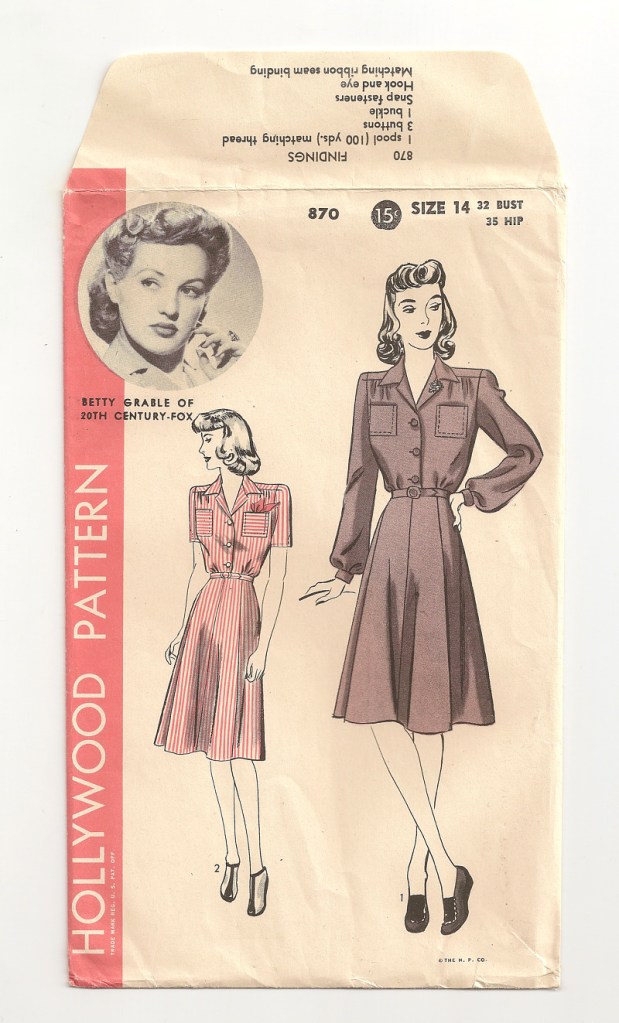
I love the Smithsonian. I think everyone should visit it, although it likely would take a month to make it all the way through the museums. I was wandering around the catalog of the Museum of American History, looking for the dress I mentioned in my last post, and lo and behold what should I find but that the Smithsonian has sewing patterns! Specifically, these two patterns, though there may be more that I haven’t found. Amazing. The first is the iconic Ginger Rogers on Hollywood 1111, circa 1933. The second is Betty Grable on Hollywood 870 from the forties. The Betty Grable one is an odd choice, since there are so many cuter ones with her on it, but I’m not a curator, so what do I know?

Hollywood 870, circa 1940s.

I was more than a little surprised to see at first glance that they do not have any of the Lucille Ball patterns there. She was truly a beautiful woman, and there are some pretty phenomenal patterns featuring her (and Desi). I wonder how they choose what they add. If there are any curators out there, I’d love to know more.

designers, vintage clothing, vintage fashion

Bringing the Extra to Extra

I’ve had this sheet music for a while and have always said that it would look great framed. It’s from the 1944 movie “Lady in the Dark,” and features Ginger Rogers in all her glory. That costume is fantastic.

I saw this post on the Victoria & Albert Museum’s Instagram the other day and it explained why this dress is simply iconic. This costume was designed by Edith Head. She, of course, went on to win eight Academy Awards for costume design. At the time the beauty was designed, it cost $35,000 to make ($15,000 of that was the mink). That equates to about $571,000 today. For ONE dress. It is said to be the most expensive costume in movie history. Ms. Head was right when she said that it simply couldn’t be made today unless a studio gave the costume designer an open wallet. Funny thing is that Ms. Head wasn’t even supposed to be the costume designer for this movie. Valentina was, but Ginger Rogers didn’t like her designs, so they brought in Ms. Head. Serendipitous.

Photo: V & A Museum, Instagram.

What makes it even more amazing is that this was done in 1944 — smack in the middle of wartime. So much for fabric rationing, though the actual amount of fabric is pretty small, but those sequins. WOW. And mink trim and train? Yep. Couldn’t be done today.

Original movie dress and jacket, embellished with faux stones and mink. Photo: Edith Head, by Jay Jorgensen.

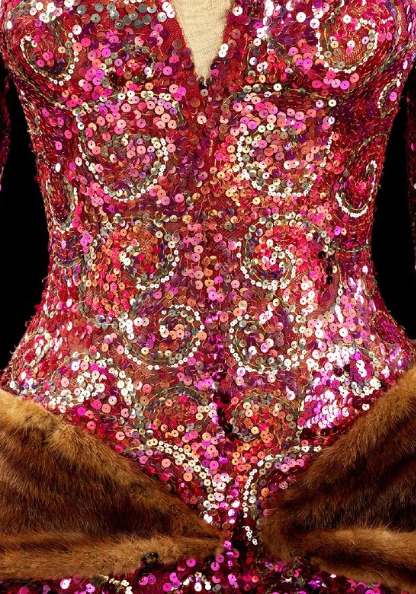
Pretty fantastic, huh? It appears that this dress is the sequined version. Two versions were made, according to the book Edith Head: The Fifty Year Career of Hollywood’s Greatest Costume Designer, by Jay Jorgensen. The original dress and matching mink jacket had faux jewels applied to create the shimmering effect, but when Ms. Rogers tried it on, it was too heavy to wear during the dance scenes. They created a second, sequined dress. That dress was worn during the dance scenes, and Ms Head later took it to the fashion shows she would host. The original dress with the stones was shown in two scenes of the movie, then was donated to the Smithsonian, though I haven’t been able to verify that it is still there.

Sequined version of the dress. Photo: Edith Head, by Jay Jorgensen.
sewing, sewing patterns, vintage clothing, vintage fashion

1964 Pattern Sizing

Ever wonder what the heck those “Miss”, “Chubbies”, “Junior Miss” and the like labels mean? Here’s the definitions of the Simplicity designations, as of 1964:

Girl: about 5′ in size 14. Girls patterns are designed for a growing figure which is still immature. It has less need for dart-fitting than the other types. Size 14 would be a 32″ bust, 26″ waist, 35″ hip.

Chubbie (I hate this label): About 5′ in size 14 1/2C. Chubby patterns are designed for a figure about the same height as the Girl, but rounder. Back waist length is 1/2″ longer than girl. Size 14 1/2C is Bust 34 1/2″, Waist 31″, Hip 37 1/2″,

Sub-Teen: About 5′ 1 1/2″ in size 14s. Sub-Teen patterns are for a figure still growing but beginning to mature, with more bust than Girl. Size 14s would be Bust 33″ Waist 26″, Hip 36″.

Teen: About 5’3″ in size 14t. Teen patterns are designed for a figure more developed and taller than the Sub-Teen, but not as tall as the Junior figure. Size 14t would be Bust 34, Waist 26, Hip 36.

Junior Petite: About 5’1″ in size 11jp. Junior Petite patterns are designed for a well developed figure which is diminutive in size. This is a size, not an age group. Size 11jp would be Bust 33″, Waist 24 1/2″, Hip 34 1/2.

Junior Miss: About 5’5″ in size 13. Junior Miss patterns are designed for the developed figure that is not as tall as the Miss. For size 13, measurements would be Bust 33″, Waist 25 1/2″, Hip 35″.

Miss: About 5’6″ in size 14. Miss patterns are designed for a well proportioned, fully developed figure that is taller than any of the other types. Bust in size 14 would be 34, Waist 26, Hips 36.

Half-Size: About 5’3″ in size 14 1/2. For a fully developed figure, shorter than a Miss-Woman with narrower shoulders. Waist and hips are larger in proportion to bust. Size 14 1/2″ would be Bust 35″, Waist 29″, Hips 39.

Women: About 5’6″ in size 44. Women’s patterns are designed for the larger, more fully mature figure that is about the same height as a Miss.

sewing, sewing patterns, vintage clothing, vintage fashion, Vintage Kids

The Peter Pan Dress

Standard Pattern 2023, 1906.

I recently came across the term “Peter Pan Dress” in a 1906 magazine, and wondered what it was so of course I did some research. It was a popular style of the time, of course brought on by the publishing of the Peter Pan stories. The first installment was published in 1902, with further installments in 1904, 1906 and 1911.

Peter Pan Dress, 1907.

The Peter Pan dresses debuted in 1906, and were were made from gingham, lawn, linen or henrietta (a fine, twilled light wool). They were considered to be “outing outfits”, to be worn for play outside. The dresses purchased in shops were made for ages 2 to sixteen. The older girls’ styles (known as “misses’) were usually done as suits, while the younger styles were done as dresses. The dresses generally featured a lowered or dropped waist, pleated skirt, and cuffed sleeves. They usually had some type of emblem embroidered on the collar — often a nautically themed one such as anchors. They sold for $2.75 to $7.50.

By 1912, advertisements are seen for Ladies’ Peter Pan dresses, perfect for “the dressy garment for the office girl or shop girls,” and made in women’s sizes up to 40. These dresses were made from serge or silk.

The style seems to have died by 1913, when mentions are made only of the Peter Pan collar, which continues today.

Peter Pan Dress, 1906.
1950s fashion, sewing, sewing patterns, vintage clothing, vintage fashion

Advance Imports

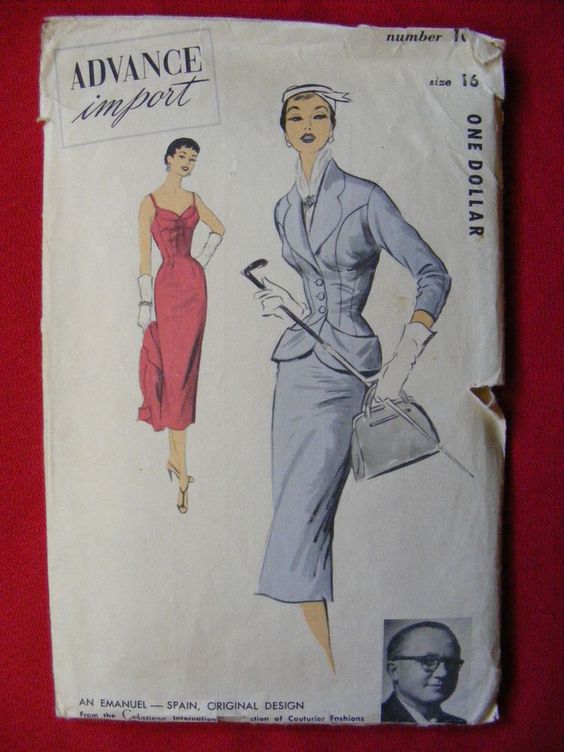
Advance Import 105, circa 1954. Photo: Merete Hvalshagen 

I cam across this pattern on Pinterest today and was fascinated. Advance Import patterns are hard to find. It’s difficult to use the word “rare” for anything that is mass produced, so let’s say they were limited editions, so not many still exist today. I’ve had a number of them over the years, but never two copies of the same pattern. They aren’t easy to find, and there are collectors who covet them fiecely. They are always fashion-forward and couture styles, like this one.

It’s always been presumed that the Advance Import line was created to do line-by-line copies of designer garments, likely out of Paris, but I don’t think I’ve ever seen one with the actual designer’s name on it. I’ve often said that one day in my spare time (that I don’t have), I will sit down and try to match pattern to designer, but of course I haven’t done that yet. I’m not even sure how many Advance Import designs were created. If there are more like this with the designer’s name on it, it’ll make the job easier.

I also can’t find much about Emanuel of Spain, though he made some awfully fetching suits like this one. Isn’t it pretty?