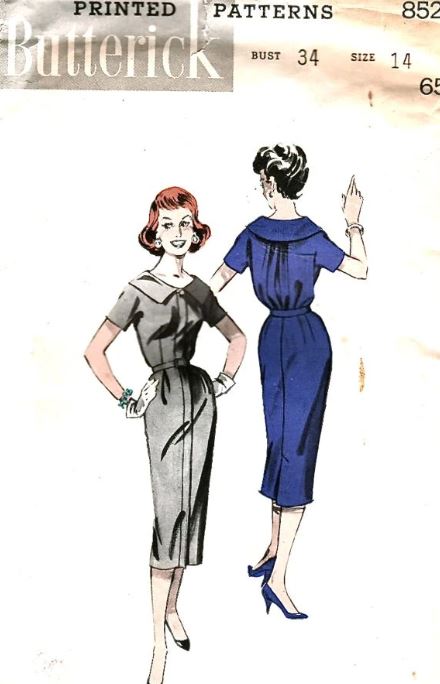
I’m working on adding this chic beauty to the website. They call it a Spectator Dress, so of course, I went digging, as that’s not a term I’ve heard before. Two toned specator shoes, yes. Dress? Not so much.
Turns out that it’s a term for a shirtwaist dress. It is first seen in 1927, as a dress to be worn while watching tennis, polo or golf. The term is seen all the way through World War II and beyond, into the 2000s. Styles vary. It might be seen as a a super simple linen sheath, perhaps with pockets, or it can also have some oomph, like silks with added French cuffs or a tucked bodice. This one has two special accents: a bloused back, which I’m not sure works that well. I think it may give a broad shouldered person a bit more room to move, but I would have to be convinced that it wouldn’t look poufy and look like a hump back there. I do love the collar though. It also has a hidden zipper front, so it’s easy to get on and off, which I am always a fan of.
I was trying to put a date on a Bestway pattern that I recently received, and came across this. Bestway Patterns are British, and the numbering is odd. In the thirties, they seem to have five digit numbers, but it evolved to a lettering and puncuation system later. The one I have is C. 1,019, so it must be around this era. You also have to take into account the years of wartime fabric rationing in Europe, which were much longer than in the US, and much more strict.
The pattern I have is a shirtwaist dress with pleated bodice and skirt, and falls below mid knee. The hairstyle is similar to this one, so it can’t be thirties, and since fabric rationing was throughout the forties in the UK, I figured it was, at earliest, 1950. That’s how I found this one.
This dress ad is dated March of 1950, from a Liverpool newspaper, and as you can see, is plainly noted as a Christian Dior style. Not only that, it is advertised as the first Christian Dior pattern made available to the public, three years after his first collection was seen on the runway. It is not, however, labelled as such anywhere on the envelope. This is how much you have to dig sometimes to realize that it is a designer pattern. There is a set of McCalls patterns from the sixties that are Biba, but not openly marked as such as well. It’s well worth it to see exactly what you may have. The pattern companies did not always make is simple.
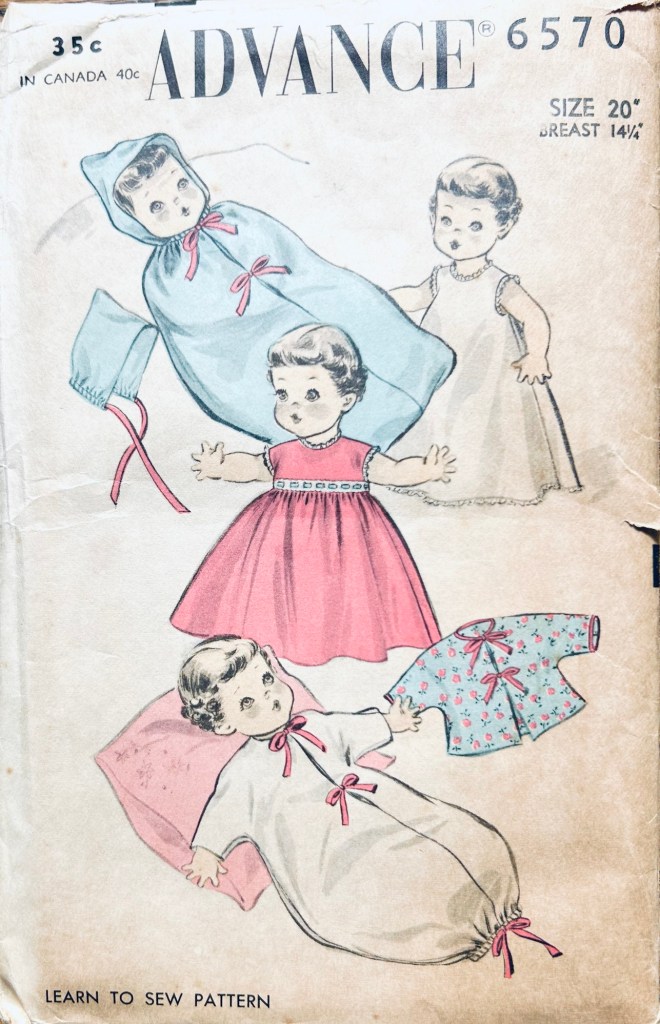
I never quite know what I’ll come across in my stash, so when I saw this little cutie, it intrigued me. It’s a Learn to Sew pattern from Advance, which I’m pretty sure I’ve never seen, especially when I read the instructions:
The pretty side. Isn’t that the cutest thing ever? Apparently this series of patterns were written for children doing their first sewing projects, so they are written especially for children. I suspect that I would do well with these instructions. I hope to find more like this, because I just think it’s the sweetest thing ever. And the pattern is cute too.
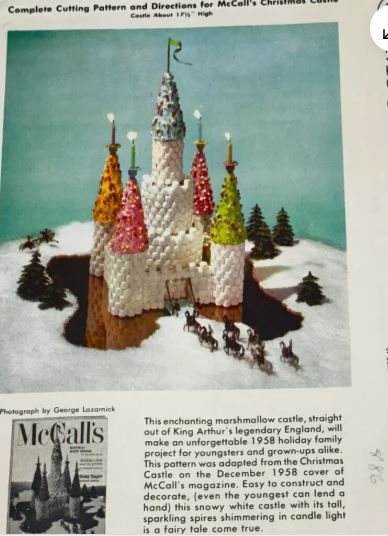
In looking for something totally different, I came across this pattern on eBay. I couldn’t really tell from the thumbnail what it was, but then I realized — it’s a castle built from mini-marshmallows! The pattern has templates to cut cardboard as the base, then you apply minis or dinner mints to create the effect. I’ve seen so many patterns over the years, but I’ve never seen one made from something edible! Is this a one-off, or have you ever seen something like this from a pattern (not a recipe)?
I came across a picture of this label in a book I was listing, called Textiles and Clothing, from 1923. I hadn’t though of the National Consumers’ League in quite a while, and didn’t really know the history, so of course I was interested in finding out more.
The book states that it had existed for 25 years, which means it started around 1898. In reality, it started with four chapters in four states in 1890, with the National Consumers’ League being established in 1899, with the purpose of protecting workers in sweat shops. It was trying to improve working conditions as well as wagers for the workers, most of whom, of course, were women. The labels were affixed to clothing “manufactured in factories under sanitary conditions.” They do have the disclaimer that the label is not a guarantee as to hours or wages, but does mean that it was not produced with child labor. I guess that they had to start somewhere, right? It also meant that state labor laws were obeyed.
The Consumers’ League also published what they called a “white list” of stores that treated their employees fairly. Socially conscious shopping in the Victorian era! Who knew? In reading their goals in an 1899 newspaper, it reads much like the anti-fast fashion movement now: their “chief purpose….is to persuade buyers to practice the new economic virtue of creating excellence by buying excellence,” and to “educate consumers or buyers by bringing before them the conditions under which goods are made and sold, and urge upon them the importance of giving patronage where good goods prevail.” And over 120 years later, we are still fighting that fight. Though child labor and working conditions have been improved in most of the US, many companies have just moved overseas, where sweat shops are still a thing.
The Consumers’ Union originally started in the eastern states, where sweatshops were more prevalent, but by the next year, it was spreading across the country. In Minneapolis, the first attempt to start a branch failed in 1898, but by the next year, it was being well established, with the hard work of a Presbyterian minister. A 1906 article in Cleveland’s Plain Dealer states that all of their funds were obtained mysteriously, without any type of fundraising.
The ladies of Cleveland led the charge during the Christmas season, pushing customers to do their shopping early, so as not to wear out the clerks over the holiday season. They also visited managers to try to get them to give the clerks more rest breaks. You can imagine how this went over! One manager indignantly replied “you have no right to question me…I have as much right to go to your home and inquire how you treat your cook!” Oh, the fragile male ego…….still alive and going strong today!
In 1935, the League was fighting the state of Virginia, where a ten hour day was permitted for female workers, with no maximum. They petitioned to have the womens’ work week limited to 48 hours. Their work has touched all aspects of worker’s environment, from minimum wage to utilities, and everything in between. It is still active today, though they do receive some criticism these days, such as receiving financial support from Amazon, not an icon of fair treatment of employees.
It’s been a long time, I know. For some reason, I just could NOT get WordPress to let me into the site. Despite never changing anything at all, I couldn’t log in, and I finally gave up trying for a while. Today, I decided to really track down the problem, went to sign in and voila! I’m in. I have no explanation, other than perhaps WordPress was being moody. Ugh.
A lot has happened since I last posted. I opened a brick and mortar shop in our small town. It’s a fabric and arts & crafts supply store. Think a very mini-Joanns. I don’t have my patterns here because it’s too small right now, but if it grows, I can get a bigger space and bring them over. Meantime, I have a growing fabric collection, along with a LOT of other stuff.
When my husband was alive, this was the one thing he didn’t support me in doing. He was adamantly opposed, in fact, which was unusual, because he supported everything I ever did, especially my pattern business. But this? No. I grappled with that a lot when I was thinking about doing this, because why did he not support it? I really needed something to do, because it was coming up on a year since his death, and one can only sit on the couch and stare at the walls for so long before one loses one’s mind. Then JoAnn’s had its financial woes, whatever they are, and I thought “why not?” But it bothered me that hubby had not been supportive. What did he know that I didn’t? He had been a small business owner and had owned several of his own shops over time. What was I missing?
I finally came to realize that he was supportive of everything I did because he knew that I would outlive him, and he wanted me to be financially stable. He supported me getting my master’s degree, and even wanted me to get my nurse practitioner — something I would’ve done if it was a thing when I was younger, but not now. But then I realized that he was afraid of me not being stable financially, because the last business he owned, his partner embezzled thousands of dollars and he lost the business. He was afraid of having something happen that would ruin me. Once I realized that that was why he didn’t want me to do it, I decided not to be afraid and to just jump in.
I decided this in early April, and got the keys to the shop May 1. By the first week of June, we were open, and it’s been nonstop since. People seem to like it. I’ve gotten lots of good feedback, and it gives me a reason to get up in the morning. I’m meeting lots of local people, which hadn’t happened before because I was a caregiver. I’m really loving what I’m doing, and it’s fun to come in and see all the beautiful colors in the shop, as well as the things that people create.
Life is good.
So I’m back, and if WordPress decides not to be moody anymore, than I will be posting again. It’s been too long.
I was listing this 1935 Excella catalog in the Etsy shop, and I fell in love with this. The one on the left. The one with the collar that could be mistaken for wings. The Dumbo of dresses, if you will. Isn’t it amazing?
The seams. The buttons. The topstitching. Everything combines to make it a memorable garment to enter a room in. This is why I love the 30s so much. It hugs the curves but can stand alone in it’s style. You wouldn’t even need much in the way of accessories for this look to sing. And lest you think that that collar would indeed take flight — NO. The topstitching would help it stay in place just fine.
I got this 1931 McCall Quarterly catalog recently. When I was listing it in the Etsy shop today, I came across this article, and it made me smile.
“Sports frocks are somewhat uniform in style. Street dresses have many characteristics in common. But the afternoon costume is another story.
In fact, the formal day mode is varied to the point of appearing irresponsible. But there is really a chic purpose behind each of its moods.
The three models that you see on the right were created for early afternoon hours. and underemonious events. Their formality hints of the casual…in simplicity of lines…fabrics taht are not too elegant…skirts that clear the floor by about ten inches.
For later hours and more formal occasions, designs become a little more feminine, fabrics a ilttle more elegant and skirts quite a bit longer. Sleeves may be either long or short. For a change you may prefer the full-length sleeve in the same from with an ankle length skirt. This combination has a provocative new look about it. “
They go on to talk about choosing accessories: gloves long enough to wrinkle at the wrist, and purses chosen as ornamental, not utilitarian.
It’s funny to look at this with today’s eyes, as we would likely never consider these beautiful garments to be irresponsible or even anything but elegant. But then again, today’s sportswear is anything but elegant, and thinking of an afternoon dress has likely never occurred to the majority of the population. I love this insight into the psychology of fashion in the 30s. It’s one of the reasons I love studying fashion so much, and why, as Miranda Priestley so eloquently put, it’s not just a blue sweater.
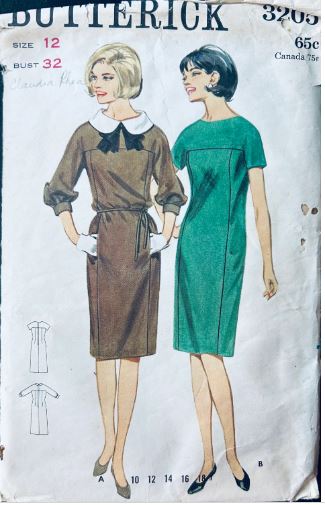
This pattern is a prime example of how one pattern can serve up two completely different garments. The difference is in the details. It’s Butterick 3205, from 1964.
View B is simple and chic. So simple that you may think it’s boring, but the lines are beautiful, and the minimalistic look is perfect for accessorizing with jewelry, scarves or even a cardigan. The lines point upward, so if you want to draw the eye to a long neck, look at the seams and the slightly widened neckline. Ito also accentuates the bust, but I’d have to see it on to see if that horizontal seam cuts across the bustline in a wonky way. I’d add pockets.
View A is a bit flashier, while also giving a hint of babydoll. That wide peter pan collar and bow is a cute way to accessorize without bling, and gives a young look that pays homage to the Twiggy era of looking like a woman-child. The below elbow length sleeves are a nice effect to cover up arms for a chilly day. The pockets here are in an odd place. It seems like if you put anything in them it would look quite problematic and make you look like a kangaroo. I’d put them into the side seams instead.
So one pattern, two looks. Simple or shuzhed up. Which would you make?
You may have wondered where I’ve been, or maybe you haven’t. It was a terribly rough year in 2023. After losing my husband in May, I kind of sat back and gave myself some grace, trying to figure out what my life looks like now. To say I have lost my center would be a gross understatement.
My husband and I never should have been together, but there we were. He was 18 years older than me, and not healthy when I met him. He was retirement age. I had years to go. He was shorter than me, though not by much. I still miss him saying “tall girl, come get this off the shelf for me.” He was my rock. My sounding board (he LOVED work gossip!). My encourager in chief — after many years of thinking about it, I finally finished my bachelor’s degree, then got my master’s, then quit working, all in pretty rapid succession. He was my person, and I was his.
But it was about more than losing the love of my life. I had lost my mom 18 months before my husband, and my dad 18 months before that. My brother had died a couple of years before my dad. Then I had to have my son’s dog euthanized while he was on vacation, and shortly after, my own dog. Like I’ve told people this year, the mortality rate is pretty high in my milieu — you may not want to get too close!
That being said, when you marry someone 18 years older than you, you do know that the odds are that you will outlive them, so I pretty much knew what the future would be from the beginning. I had a few trial runs whilst he was in the hospital before he passed, because he was gone for weeks at a time. Truth be told, he was in the hospital MUCH more than he was home for the last three months. So I knew what was coming, especially because I was a nurse. That doesn’t mean a darned thing to that monster called grief, because it rears its head and doesn’t let go easily. Pack on top of it the multiple losses on top of the loss of my husband, and I needed a minute.
So I stepped back, pondered, cried, took some trips, moved a stepson out, moved a son in (both a very good thing), and am trying to get my house in order now, in more ways than one. I have lots to share, so expect to see me back, for better or for worse. And if you too are clinging for dear life against the tide of grief, I see you. I understand. I hope that you have as awesome a support network as I do, and if you don’t, that’s ok. Reach out to me. I’ll listen.
Tomorrow I am off to see the Downton Abbey exhibit in Chicago, so I’ll be back with lots to tell you.






 The Vintage Fashion Librarian